
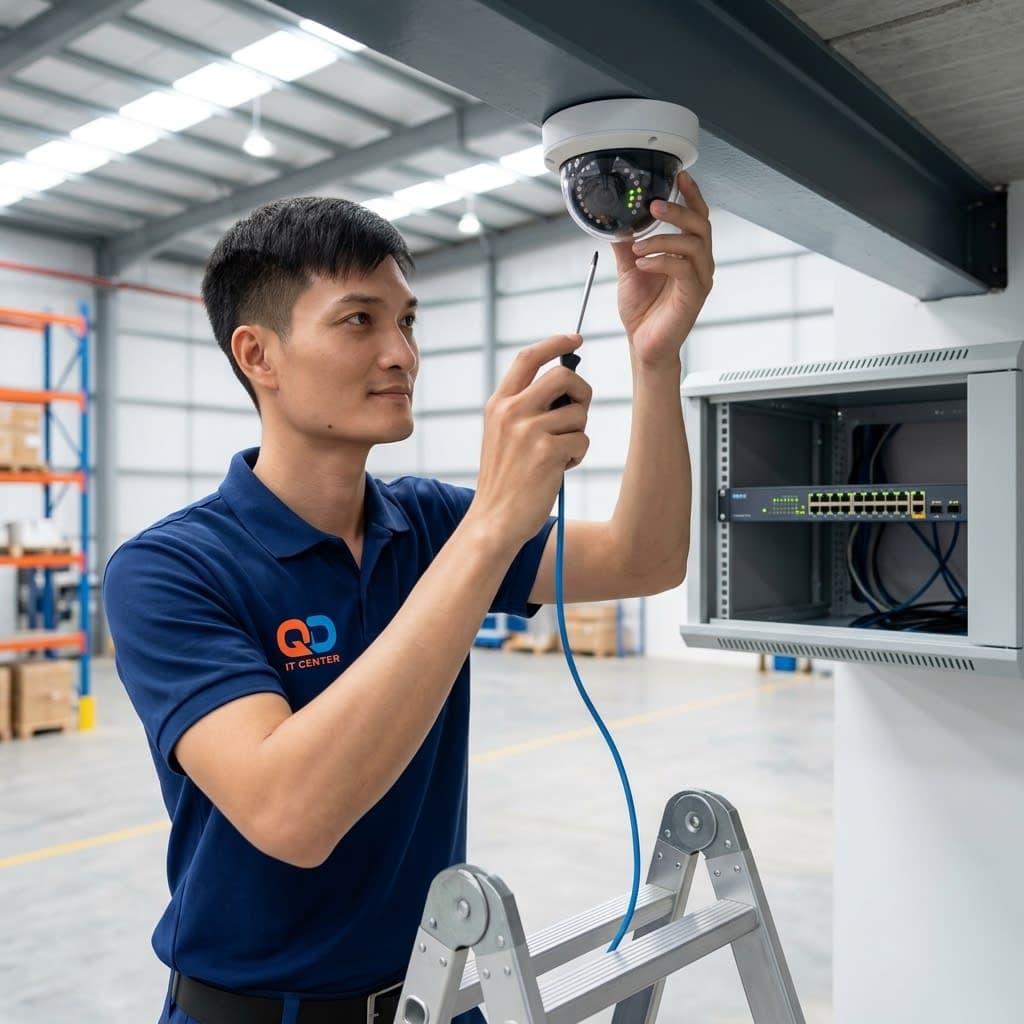
PoE IP Cameras: A Cost-Effective Cable Surveillance Solution for Businesses
A traditional analog camera installation project for a factory with 20 cameras typically incurs separate wiring costs for power and signal cables of up to 15–25 million VND, not including the 3–5 days of installation labor. With IP PoE cameras, businesses can cut these costs by 30–40% thanks to a single CAT6 network cable that provides both power and video transmission.
This article provides a detailed analysis of PoE (Power over Ethernet) technology in IP cameras, compares it to traditional analog systems, and guides businesses in choosing a solution suitable for their factory, office, or showroom size.
What is PoE and Why Are PoE IP Cameras Replacing Analog Cameras?
Power over Ethernet (PoE) is a technology that transmits electrical power over the same Ethernet network cable used for data transmission. With PoE IP cameras, technicians only need to run a single CAT6 cable from the switch to the camera — no separate 220V power line is required.
The core benefits of PoE in security monitoring.
- Reduced material and labor costs: No need for a separate electrician, no need for power outlets at each camera installation location.
- Safer: The voltage transmitted through PoE is only about 44–57V DC, much safer than 220V AC, making it suitable for humid or outdoor environments.
- Flexible installation location: Cameras can be placed in corners of roofs or gates far from power sources.
- Centralized management: PoE switches allow for remote power on/off of each port, supporting the reset of suspended cameras without needing to climb to the installation location.
- Easy UPS compatibility: Simply connect the UPS to the central PoE switch, and all cameras will continue to operate even during a power outage.
Comparing PoE IP Cameras and Analog Cameras (CVI/TVI/AHD)
Criteria
PoE IP Camera
Analog Cameras (CVI/TVI/AHD)
Cable type
1 CAT6 cable (power + data)
Coaxial cable + separate power cord
Maximum resolution
4K, 8MP, 12MP
Typically 2MP–5MP
Wiring costs
30–40% lower
Height due to two parallel wires
Maximum transmission distance
100m (without extension), up to 250m with PoE extender.
300–500m (coaxial)
Integrating AI/intelligent analytics
Yes (facial recognition, people counting, restricted area alerts)
Limit
Scalability
Easy — add PoE switch, VLAN
Difficult — limited number of DVR channels
Open Standard (ONVIF)
Have
Are not
Essential PoE Standards for Businesses
Not all IP cameras use the same PoE standard. Choosing the wrong standard can result in insufficient power for the camera, especially for PTZ (pan-tilt-zoom) cameras or cameras with high-power infrared lights.
802.3af (PoE) — The basic standard
- Maximum power consumption: 15.4W at the source, actual power output ~12.95W at the device.
- Suitable for: fixed IP cameras with 2–4MP resolution, without heating/fan.
802.3at (PoE+) — The most popular standard today.
- Maximum power consumption: 30W at the power source, actual power output ~25.5W at the device.
- Suitable for: 4MP–8MP cameras with high-power infrared lights, cameras with anti-fog heating.
802.3bt (PoE++/UPoE) — Standard for high-power devices
- Maximum power: 60–100W depending on the type (Type 3/Type 4)
- Suitable for: 360° rotating PTZ cameras, speed dome cameras, cameras with built-in speakers/siren.
Technical note: When designing the system, you need to add up the total power consumption of all cameras and compare it to the total power capacity of the PoE switch (PoE budget). Exceeding the power budget will cause some cameras to fail to power on even if the switch has free ports.
Resolution and ONVIF Standard: Choosing the Right One for Your Needs
4MP or 8MP?
- 4MP (2560×1440): Sufficient for facial recognition within a range of 5–8m, suitable for offices, showrooms, and small to medium-sized shops. More economical storage capacity, and camera costs 20–30% lower than 8MP.
- 8MP (4K, 3840×2160): Essential for large areas such as parking lots, factory gates, where digital zoom is needed to read license plates or identify details at a distance.
ONVIF standard — avoid being locked to one carrier
ONVIF (Open Network Video Interface Forum) is an open communication standard that allows cameras from different manufacturers (Hikvision, Dahua, Uniview, etc.) to be compatible with the same NVR or video management software (VMS). Businesses should request that their suppliers confirm that the cameras meet the ONVIF Profile S (basic video streaming) standard or higher in order to:
- The system can be easily expanded with cameras from other manufacturers in the future.
- Not dependent on proprietary software from a single manufacturer.
- Easily integrates with building management software (BMS) or third-party AI software.
PoE Switch: The Heart of the IP Camera System
A PoE switch is not just a regular network switch — it's the power source for the entire camera system.
Checklist for selecting a PoE switch for your business.
- The total PoE budget must be at least 20% greater than the actual power consumption of the camera (to account for potential load increases).
- VLAN support helps isolate the camera network from the office data network, preventing bandwidth congestion.
- There are Gigabit or 10G uplink ports if the number of cameras exceeds 16 channels.
- Supports web-based management (managed switch) to monitor the status of each port.
- It has a Watchdog feature that automatically reboots the port when it detects the camera is unresponsive.
- Integrated surge protection for outdoor environments and factories.
Managed and Unmanaged PoE Switches: What's the Difference?
For systems with fewer than 8 cameras, an unmanaged PoE switch is sufficient and cost-effective. However, businesses with 16 or more cameras should invest in a managed switch to:
- Monitor the power load on each port to prevent switch overload.
- Configure a separate VLAN for the camera system to enhance network security.
- Schedule automatic reboot of the PoE port when the camera freezes (PoE scheduling)
Applications of PoE IP Cameras for Businesses and Factories
Factory
4MP–8MP PoE IP cameras installed at entrances, raw material warehouses, and production lines help monitor workplace safety and prevent product loss. Integrated AI features for counting people entering and exiting facilitate shift-based personnel management.
Office and commercial buildings
4MP cameras in the lobby, elevators, and parking lot, combined with facial recognition technology, support access control without the need for key cards.
Showroom, retail store
Integrated PoE IP cameras with customer behavior analysis (heatmap, customer count) help business owners optimize store layout and measure product display effectiveness.

Estimated Investment Costs for PoE IP Cameras
Category
Camera coordinates
PoE IP Camera
4MP Camera (unit price)
There is no equivalent.
1,200,000 – 2,500,000 VND
8-channel DVR/NVR
2,500,000 VND
3,500,000 – 5,000,000 VND
8-Port PoE Switch
No need
1,500,000 – 3,000,000 VND
Wiring costs (20 cameras)
15–25 million VND
9–15 million VND
Estimated total cost for a 20-camera system.
~65 million VND
~78 million VND (but saves on operating costs and provides sharper images)
The initial cost of an IP PoE system may be slightly higher than analog on a smaller scale, but this is offset by lower wiring costs, higher image quality, and AI scalability later on — the total cost of ownership (TCO) over 3–5 years is typically 15–20% lower.

Quang Duc's PoE IP Camera Installation Service
Quang Duc Electronics and Telecommunications Co., Ltd. provides comprehensive PoE IP camera solutions for businesses, factories, and commercial buildings, including:
- Conduct a site survey and design a camera system layout that suits the area and budget.
- We supply genuine ONVIF-compliant PoE IP cameras with resolutions ranging from 4MP to 8MP.
- Standard CAT6 cable installation ensures stable signal transmission over long distances.
- Configurable PoE switch, secure VLANs, integrated NVR/cloud storage.
- Equipment warranty, scheduled maintenance, and 24/7 technical support.
Quang Duc's technical team has deployed PoE IP camera systems for dozens of factories, showrooms, and offices in the area, ensuring fast construction progress and stable long-term operation.

Conclude
PoE IP cameras not only help businesses save on wiring costs but also open up possibilities for AI integration, flexible scalability, and centralized management—values that traditional analog cameras cannot provide. With the right PoE standard, optimal resolution, and a professionally managed switch, businesses can have a sustainable surveillance system for years to come.
If your business is considering upgrading its security camera system, let Quang Duc advise you on the most suitable PoE IP camera solution for your scale and budget.
Hotline: 0903 306 126 (Mr.Vũ Trần) | Website: cameraquangduc.vn


