
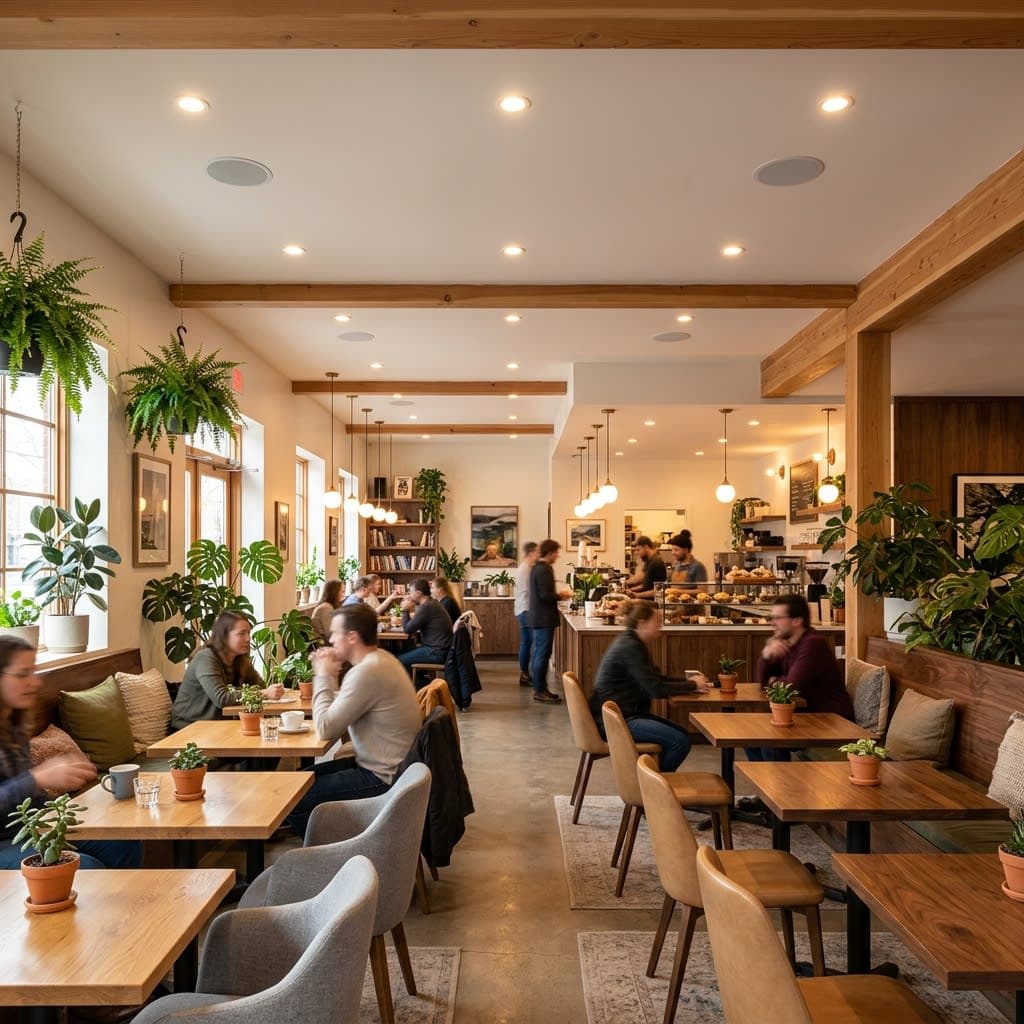
Designing a Professional Entertainment Sound System for Cafes and Restaurants
According to a 2025 F&B industry survey, over 70% of customers rated the musical experience as the second most important factor after the quality of drinks/food when deciding to return to a cafe or restaurant. However, many owners still use unsuitable portable Bluetooth speakers or home sound systems, resulting in uneven sound, with some areas louder than others, directly affecting the experience that customers pay for.
A well-designed entertainment sound system not only plays music but also contributes to shaping brand identity, retaining customers longer, and increasing the likelihood of repeat business. This article provides detailed instructions on how to design a professional sound system for cafes and restaurants.
Why do cafes and restaurants need to invest in professional sound systems?
- Create a consistent experience: Uniform volume at every seating position, no more situations where the speaker is too loud at tables close to the table and inaudible at tables further away.
- Brand positioning through music: An acoustic space that matches the bar's style (chill, indie, jazz, light EDM, etc.) helps customers remember a unique experience.
- Increased length of stay: Pleasant, non-straining sound encourages guests to stay longer, increasing the likelihood of ordering more drinks.
- Spatial aesthetics: In-ceiling/in-wall speakers are discreetly hidden, not disrupting the interior design like bulky portable speakers.
Component 1: Ceiling Speakers and Wall-Mounted Speakers
Ceiling Speakers
It's the most popular choice for cafes and restaurants due to its high aesthetic appeal — the speakers are recessed into the ceiling, with only the small, compact round speaker cone visible, taking up no floor or wall space.
- Recommended power: 6-10W/speaker for spaces with ceiling heights of 2.5-3.5m
- Installation density: On average, 1 speaker per 12-15m2 to ensure even sound coverage.
- Installation location: Avoid installing close to walls or corners of the room as this causes sound reverberation; instead, arrange them in an even grid across the ceiling.
Wall-mount Speakers
Suitable for spaces with low ceilings, thin plasterboard ceilings that lack sufficient depth for recessed ceiling installation, or outdoor areas with a roof (garden cafes, garden pubs).
- Advantages: Easy to install, easy to adjust speaker direction to optimize coverage.
- Disadvantages: Less aesthetically pleasing than ceiling speakers, takes up wall space.

Component 2: Power Amplifier and Signal Processor
The amplifier is the "heart" of the system, determining the quality and stability of the sound:
- Amplifier power: A 20-30% reserve is needed compared to the total rated power of all speakers to avoid distortion and speaker damage when operating continuously for many hours.
- Number of zones: For restaurants with multiple areas (main hall, VIP rooms, garden), a multi-channel amplifier is recommended to allow independent volume control for each zone.
- Signal mixer: Allows connection of multiple sources (phone, computer, event MC microphone) and flexible switching.
Music Source
Nowadays, the most common method of playing music is through streaming apps (Spotify, YouTube Music) connected via Bluetooth/Wifi to a central receiver, instead of a traditional CD player.

Component 3: Sound Coverage and Speaker Placement in the Space
Designing the sound coverage zone is the most important but often overlooked step. The basic principle is:
- Divide the restaurant space into functional areas: main seating area, bar area, VIP area, and garden area.
- Each area should have at least one dedicated speaker zone to easily adjust the volume as needed (the VIP area needs to be quieter than the main area).
- Calculate speaker spacing based on ceiling height and area to avoid "dead zones" (areas where sound is unclear) or overlapping sound that causes noise.
Speaker Density Suggestion Table Based on Area Size
Area of space
Recommended number of ceiling speakers
Power/Speaker
Under 50m2
4-6 speakers
6W
50-100m2
8-12 speakers
6-8W
100-200m2
15-20 speakers
8-10W
Over 200m2 (multi-zone)
Separate zones, 20+ speakers
8-10W, multi-channel
Component 4: Balancing Bass/Treble Suitable for F&B Spaces
Sound quality depends not only on power but also on how the frequency range is handled.
- For a relaxing, chill cafe atmosphere: Prioritize warm mid-range frequencies and gentle treble, avoiding overly strong bass that can create a noisy feeling.
- In lively restaurants and bars: You can slightly increase the bass to create a boisterous atmosphere, but control it to avoid echoes in enclosed spaces.
- VIP room, quiet space: Reduce overall volume, balance all frequency ranges, avoid harsh treble that can be unpleasant during conversations.
Modern amplifiers utilize integrated DSP (Digital Signal Processing) technology, allowing for precise EQ adjustments tailored to the specific physical characteristics of each space.

Multi-Zone Control System for Restaurants with Multiple Spaces
For cafes and restaurants with multiple areas (ground floor, upper floor, garden, private rooms), centralized yet flexible sound control for each area is crucial to optimizing the experience.
- Independent control for each floor/zone: Allows for playing different music or adjusting the volume separately to suit the atmosphere of each space.
- Centralized control at the checkout counter: Staff can manage the entire system from a single point, without having to move to each area.
- Mobile app integration: Owners can monitor and adjust the volume remotely, even when not at the restaurant.
- Schedule music playback automatically: Gentle music in the morning, more lively music in the evening, automatically switching according to your set time slots.
Benefits of Intelligent Control Systems
Compared to basic sound systems with only an on/off button, a smart control system saves business owners operating time and ensures a consistent experience across shifts without relying on manual operations by staff.
Estimated Investment Costs Based on Restaurant Size
The cost of installing a home entertainment sound system depends on the size of the room, the number of speakers, and the complexity of the control system.
- Small cafes (under 50m2): Estimated investment cost is 15-25 million VND for a basic system with 4-6 ceiling speakers and a single-channel amplifier.
- Medium-sized cafe/restaurant (50-150m2): Estimated cost of 30-60 million VND for a multi-channel system with basic DSP calibration.
- Large, multi-zone restaurants (over 150m2): Estimated cost starts from 70 million VND and up, depending on the number of zones and the level of control customization.
This is a reference price; the actual cost will be calculated precisely after a site survey and assessment of each restaurant's specific requirements.
Checklist for Designing a Sound System for Cafes and Restaurants
- Measure the area and ceiling height of each section in the restaurant.
- Determine the number of audio zones that need to be adjusted independently.
- Calculate the appropriate number and power of ceiling/wall-mounted speakers.
- Choose an amplifier with a power reserve of 20-30% compared to the total speaker load.
- Design the wiring diagram and installation locations to avoid dead zones.
- Adjust the EQ bass/treble to match the style and brand positioning of the restaurant.
- Test the ability to connect to flexible music streaming sources.
- Conduct a real-world sound test at various seating positions before final acceptance.
Regular Maintenance of Entertainment Sound Systems
To ensure the sound system operates smoothly and maintains good sound quality over time, business owners should pay attention to a regular maintenance schedule:
- Monthly: Check the volume and sound quality at different seating positions to detect early signs of speaker distortion or loss of sound.
- Quarterly: Clean the ceiling speaker grilles, check wiring connections, and tighten any loose connectors.
- Annually: Perform a comprehensive check of the amplifier and DSP, and update the firmware if the system includes app control.
- When there are changes to the interior layout: Reassess the acoustic coverage if the restaurant changes the arrangement of tables and chairs, or if partitions affect sound transmission.
Regular maintenance helps prevent the speakers from deteriorating silently, a problem that the owner might not realize until a customer complains.
Quang Duc's Entertainment Sound System Design Service
Quang Duc Electronics and Telecommunications Co., Ltd. provides complete entertainment sound solutions for cafes and restaurants, including:
- Conduct a site survey and provide consultation for a suitable speaker layout design.
- We supply and install genuine ceiling speakers, wall-mounted speakers, and power amplifiers.
- Sound calibration (EQ, coverage, zone control) for optimal listening experience.
- The wiring is installed neatly within walls and ceilings, without affecting the interior design.
- Equipment warranty and technical support for routine maintenance.
With experience in implementing sound systems for numerous local cafes and restaurants, Quang Duc's technical team understands the connection between sound and customer experience in the F&B industry.
Conclude
A properly designed entertainment sound system not only provides a great listening experience but also serves as an effective brand positioning tool for cafes and restaurants. From selecting the right ceiling speakers and calculating amplifier power to designing coverage areas and balancing bass/treble, everything needs to be meticulously planned from the outset to avoid costly repairs later on.
If you need advice on designing a sound system for your entertainment venue, contact Quang Duc today for a free survey and quote.
Hotline: 0903 306 126 (Mr.Vũ Trần) | Website: cameraquangduc.vn


