
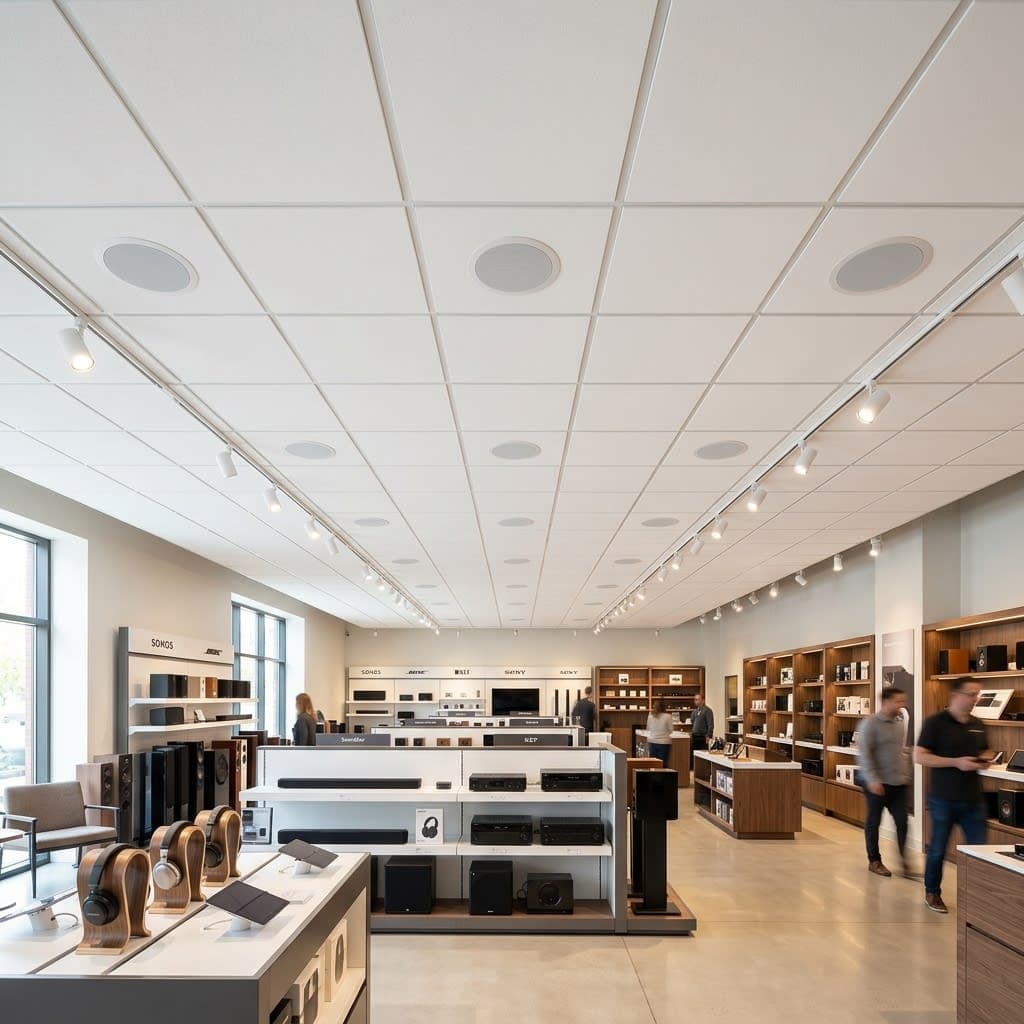
Ceiling Speakers for Office and Showroom Background Sound Systems
A modern showroom or office rarely lacks the soothing background music emanating from the ceiling without any visible speakers. According to real-world construction surveys, a 150-200m² office space typically requires 12-20 ceiling speakers, with a total investment cost of 25 to 60 million VND including speakers, amplifiers, and wiring – a significant expense if the wrong equipment is chosen or the installation is done incorrectly.
This article helps businesses understand how ceiling speakers work, how to calculate power and installation distance, compare popular product lines on the market, and grasp the principles of installation to ensure the background sound system operates reliably and does not disturb adjacent spaces.

What are ceiling speakers and when should you use them?
Ceiling speakers are speakers installed flush into drywall or modular ceilings, with only the flat, round speaker cone visible against the ceiling, creating a seamless aesthetic with no exposed speaker wires or enclosures. This is an optimal choice for:
- Office environment: background music creates a relaxed atmosphere, reduces stress, and is also used for internal announcements.
- Showroom display: creating a professional shopping experience, with sound evenly distributed to every corner without cluttering the display space.
- Reception area and hallways: playing background music, announcing event schedules.
- Small meeting room: incorporating a video conferencing system.
Unlike wall-mounted speakers often used for high-powered events, ceiling speakers focus on providing even, gentle sound coverage at low power levels — suitable for the nature of "background music" rather than performance.
Beyond aesthetics, choosing the right ceiling speakers directly impacts the customer experience in the showroom and the morale of office workers — an uneven sound coverage system can easily create a feeling of loudness in some areas and softness in others, which is more unpleasant than having no background sound at all.
Power and Installation Distance: How to Calculate Correctly
Power Rating: 6W–20W and Standard 100V Line
Office ceiling speakers typically have a nominal power rating of 6W to 20W per speaker. This power level is sufficient to create a pleasant background volume (around 70–75dB) without causing excessive noise that disrupts work. Most specialized ceiling speakers use a 100V line standard (also known as constant voltage) instead of the standard 4-16 ohm impedance.
Why Choose 100V Line Instead of 4-16 Ohm?
Criteria
100V line standard
Standard 4–16 ohm
Number of speakers connected in parallel on a single line
20–40 speakers depending on amplifier power
Limit of 2–4 speakers (due to cumulative impedance)
Maximum conductor spacing
There is no significant signal loss up to 300–500m.
Attenuation becomes noticeable below 30-50m.
Required wire cross-section
Smaller (0.75–1.5mm²)
Larger (1.5–2.5 mm² or larger)
Cost of wiring for large systems
Save 40–50%
significantly higher
Design complexity
Simple — just calculate the total power.
Complex — requires calculating total impedance.
Suitable for scale
For 10 or more speakers (offices, showrooms, shopping malls)
Small room, fewer than 4 speakers
For showrooms or offices with more than 10 ceiling speakers, a 100V line standard is almost a mandatory choice to optimize installation costs and simplify system design.
Standard Installation Distance: 4–6m/Speaker
The principle for even sound coverage on ceilings 2.5–3m high is that each speaker covers an effective radius of approximately 2–3m , equivalent to a distance of 4 to 6 meters between two adjacent speakers. For higher ceilings (showrooms with ceilings of 4–5m), the distance should be reduced to 3.5–4.5m to compensate for sound loss due to height.
Quick reference recipe:
- Room area ÷ (coverage radius × coverage radius × 3) ≈ number of speakers needed
- Example: showroom 200m², coverage radius 3m → 200 ÷ (3×3×3) ≈ 7-8 speakers (rounded up, evenly distributed across the grid)

Comparing 3 Popular Ceiling Speaker Brands: Bosch, TOA, JBL
Criteria
Bosch LC1
TOA F-122
JBL Control 26CT
Power
6W/12W (tap 100V)
6W/12W (tap 100V)
16W (tap 100V), with 8 ohm mode.
Driver diameter
5 inch (LC1-PC06-6)
5 inches
6.5 inch
Frequency response
90Hz–20kHz
100Hz–18kHz
65Hz–20kHz
Sound quality
Neutral, clear dialogue — suitable for announcements
Stable, highly durable, and popular in PA projects.
Warmer bass, suitable for high-quality background music.
Reference price/pair
Mid-range
Mid-low range
20–30% higher than Bosch/TOA
Most suitable
Office, PA system with music
Large projects require stability and long-term warranties.
High-end showrooms require better sound quality.
Suggested choices based on budget:
- Budget-friendly, durability prioritized: TOA F-122
- Balancing notifications and background music: Bosch LC1
- Premium showroom, prioritizing the music experience: JBL Control 26CT
100V Line Amplifier: The Heart of the System
A 100V line amplifier (mixer amplifier) is the central device that supplies power and signals to the entire series of ceiling speakers. When choosing an amplifier, consider the following:
- The total amplifier power should be ≥ 1.2 × the total power of the speakers to ensure a safe operating range, avoiding continuous full load operation which can cause the amplifier to overheat and reduce its lifespan.
- Independent zones: Multi-zone amplifiers allow you to divide the showroom into different music playback areas or adjust the volume individually.
- Multiple input options: Bluetooth, USB, AUX, and mic paging for flexible music playback and emergency announcements.
Checklist for choosing the right amplifier:
- Calculate the total power consumption of all ceiling speakers in the system.
- Choose an amplifier with at least 20% excess power.
- Determine the number of independent zones that need to be divided.
- Check the paging mic port for emergency announcements.
- Ensure there is a Bluetooth/USB input for convenient operation.

Proper Construction Techniques: Ceiling Cutting and Soundproofing
Installation on Gypsum Ceiling vs. Modular Ceiling
- Gypsum ceiling: Cut a circular hole with the correct diameter for the speaker (usually 165–200mm), and attach dog-ear clamps to tighten them securely into the gypsum board. Check the position of the rafters to avoid cutting into the ceiling frame.
- Modular ceiling (60x60cm): Easier to install because the entire ceiling panel can be replaced with pre-installed speaker panels, convenient for maintenance and disassembly when repairs are needed.
Soundproofing from Adjacent Office
A common mistake during construction is neglecting soundproofing above the speakers, allowing sound to leak through the false ceiling and spread to the adjacent office space through the shared ceiling gap. Solution:
- Install a back box (a enclosure behind the speaker) to direct the sound downwards, reducing sound reflections towards the ceiling.
- Use rockwool insulation around the speaker area if the ceiling is in a noise-sensitive room (e.g., executive meeting room, recording studio).
- For multi-story showrooms, speakers with sealed back boxes are preferred to minimize sound transmission through concrete floors and ceilings.

System Maintenance and Upgrades Over Time
Average Lifespan and Signs That Need Replacement
High-quality ceiling speakers have an average lifespan of 8 to 12 years if operated at the correct power and in a not-too-humid environment. Signs that indicate the need for inspection or replacement include crackling or distorted sound at high frequencies, unusually low volume compared to other speakers in the same system, or sagging speaker cones due to prolonged exposure to moisture.
Periodic Examination Schedule
Frequency
Inspection items
Quarterly
Listen to each zone to detect speaker distortion or loss of sound.
Annual
Check the wire connectors and tighten any loose clamps that may have become loose over time.
3–5 years
Overall, consider upgrading the amplifier if you expand your living space.
Expand Your System as Your Business Grows
A major advantage of the 100V line design is the ability to add new speakers to an existing system without changing the entire wiring infrastructure, as long as the amplifier has sufficient power. When a showroom expands or an office adds another floor, the business only needs to add speakers and recheck the total power against the existing amplifier's capacity — avoiding the need for a complete overhaul.
Quang Duc's Background Sound System Installation Service
Quang Duc Electronics and Telecommunications Co., Ltd. provides complete sound solutions for offices and showrooms , including:
- Survey the site, calculate the appropriate number of speakers and amplifier power.
- We supply and install genuine Bosch, TOA, and JBL ceiling speakers.
- Proper ceiling cutting and 100V wiring installation will be carried out according to technical specifications, ensuring an aesthetically pleasing result.
- Consulting on soundproofing solutions for adjacent spaces sensitive to noise.
- Equipment warranty and post-installation technical support.
Quang Duc's technical team has implemented background sound systems for numerous offices and showrooms in the area, ensuring consistent sound quality and long-term stable operation.
Conclude
Choosing the right ceiling speakers isn't just about selecting a brand; it also depends on calculating the power, installation distance, and proper installation techniques. A well-designed system provides a professional audio experience for showrooms and a comfortable working environment for employees.
If your business is considering installing a background sound system, contact us for a free survey and consultation to find the right solution for your budget and space.
Our technical team will work alongside businesses from the initial survey to long-term maintenance, ensuring the system operates stably for many years.
Hotline: 0903 306 126 (Mr.Vũ Trần) | Website: cameraquangduc.vn


