Enterprise Network Solutions: From LAN Systems to Comprehensive IP PBX Systems
Network infrastructure is the backbone of every modern business. Whether you run a 10-person office or a manufacturing company with 100 employees, a well-designed network system directly impacts productivity, data security, and monthly operating costs. This article provides a comprehensive analysis of the components of an enterprise network solution —from physical cabling infrastructure and switches to modern VoIP IP PBX systems.
1. Network Infrastructure: An Indispensable Foundation
Before considering any equipment, the network cabling infrastructure must be carefully planned. This is a one-time investment but has a long-term impact on the entire system.
Cat6 vs Cat6A — Which one should you choose?
- Cat6 (1 Gbps, 250 MHz frequency): Suitable for offices with fewer than 50 people, cable distances under 55 m when running at 10 Gbps. This is currently the most common standard with reasonable costs.
- Cat6A (10 Gbps, 500 MHz): Recommended for businesses planning expansion, server rooms, or connection points requiring consistently high bandwidth. Supports 10 Gbps over a distance of 100 m.
Practical advice: Even on a tight budget, don't skimp by using uncertified or unbranded cables. The cost of replacing the cabling system after 2–3 years will far exceed the initial price difference.
Cable Infrastructure Components
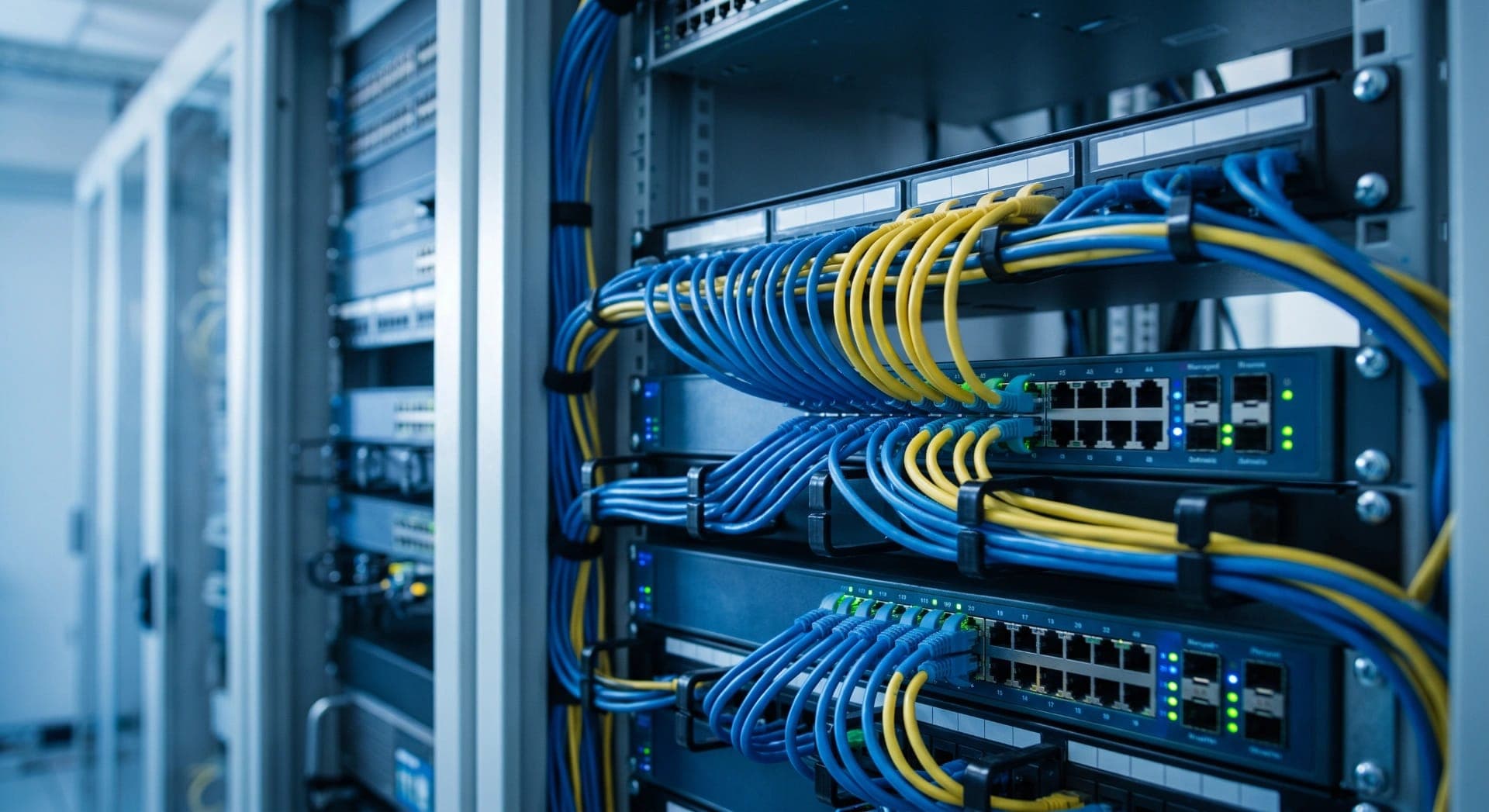
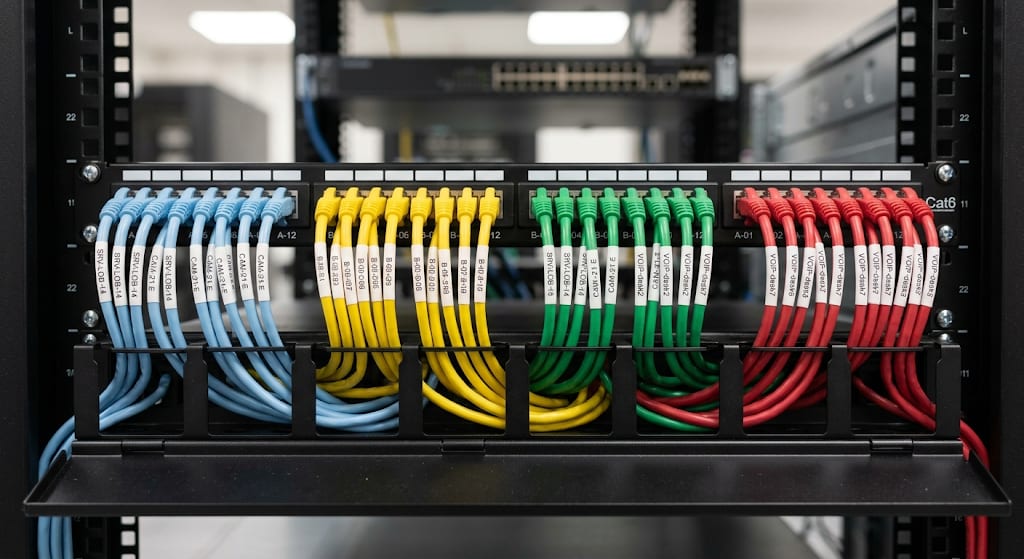
- Patch panel: A centralized connection point that facilitates easy management and reduces the risk of errors when changing configurations.
- Rack/cabinet: Protects equipment, creates a tidy management space, and supports the cooling system.
- Keystone jacks and network socket faceplates: TIA-568 standard for compatibility assurance.
2. Network Switch: Managed vs Unmanaged
Switches are the "traffic intersections" of a local area network. Choosing between managed and unmanaged switches directly impacts control and security capabilities.
Unmanaged Switch
- Plug and play, no configuration required.
- Suitable for small offices with fewer than 10 people and basic needs.
- VLAN, QoS, and traffic monitoring are not supported.
- Limitations: It's impossible to control who connects to the network, and there's no prioritization of VoIP or video traffic.
Switch managed
- VLAN (Logical Network Segmentation) support: Separates employee networks, guest networks, server networks, and surveillance camera networks.
- QoS (Quality of Service): Prioritizes voice/video data packets, avoiding interruptions in sound during transmission.
- Port mirroring, SNMP, RSPAN: Monitoring traffic and detecting anomalies.
- Spanning Tree Protocol (STP): Prevents network loops that cause system crashes.
Conclusion: Every business with 20 or more employees should use a managed switch. The cost difference is negligible compared to the benefits in terms of security and control.

3. Enterprise Routers and Firewalls
Enterprise Router
A router connects the local network to the Internet and distributes traffic between subnets. Required features include:
- Dual WAN: Connects two internet connections, automatically switching when one fails (failover).
- Load balancing: Distributing the load across multiple transmission lines to optimize bandwidth.
- Integrated VPN server: Allows remote employees to securely connect to the company network.
- Advanced QoS: Prioritize traffic by application or user.
Firewall — A Security Shield
A firewall is a device/software that controls incoming and outgoing traffic according to a set of rules. For SMEs, the minimum requirements are:
- Stateful packet inspection: Checks the connection state, not just filtering by IP/port.
- Integrated IPS/IDS: Detects and prevents common attack patterns.
- Content filtering: Blocks access to malicious websites and unnecessary social media during business hours.
- SSL inspection: Examines HTTPS traffic to detect malware hidden within encrypted connections.

4. IP PBX and VoIP Systems
This is the area that has brought about the biggest changes in cost and features compared to traditional (analog/PSTN) telephone systems.
What is VoIP and Why Do Businesses Need It?
VoIP (Voice over Internet Protocol) transmits voice over the internet instead of traditional telephone lines. Direct benefits:
- Reduce call costs by 50–70% , especially for long-distance and international calls.
- Free internal calls between all extensions within the company, including remote employees.
- Multi-device integration: Hardware IP phones, PC softphones, mobile phone apps — all sharing a single extension number.
- Rich features at no extra cost: Auto attendant, call queue, call recording, call forwarding, and conferencing.
SIP Trunk — Connecting IP PBX to PSTN Network
SIP trunking replaces traditional physical telephone lines, connecting IP PBXs to telecommunications providers via the Internet.
- Flexible channel capacity: Increase/decrease the number of simultaneous calling channels as needed without requiring additional wiring.
- DID (Direct Inward Dialing): Each employee may have their own physical phone number.
- Virtual multi-region phone number: Businesses in Hanoi can have a Ho Chi Minh City number to reach local customers.
Call Routing Feature
A modern IP PBX allows for flexible configuration:
- IVR (Interactive Voice Response): "Press 1 to speak with sales, press 2 to speak with technical support..."
- Time-based routing: During working hours, routing is done via extension, while outside working hours, routing is done via voicemail or the duty officer's mobile number.
- Ring group: An incoming call rings on multiple phones simultaneously to ensure no customer is missed.
- Call queue with hold music: Customers wait in a professional queue instead of hearing a busy signal.
5. Network Design for SMEs with 10–100 Employees
Simplified Three-Tier Model
For small and medium-sized enterprises, the simplified model includes:
- Core/Distribution layer: Router + Firewall + Switch core managed.
- Access layer: Switches managed on each floor/area.
- Edge: WiFi access point, IP phone, user computer.
Proposed VLAN Segmentation
VLAN ID
Name
Purpose
10
Editor
Network device management
20
Staff
Employee computers
30
VoIP
IP phones, prioritizing QoS.
40
Server
Internal server
50
CCTV
Surveillance cameras
60
Guest
Guest WiFi, completely isolated.
Redundancy and Scalability
- Choose a switch with at least 20–30% more ports than your current needs.
- Cable all locations that may require future connectivity, including meeting rooms and lobbies.
- UPS (uninterruptible power supply) for all core network equipment — the network must not go down in the event of a sudden power outage.
- Consider redundant internet connectivity for businesses that rely heavily on the cloud.
6. Enterprise Network Security
Essential Security Measures
- 802.1X Network Access Control: Only authenticated devices are allowed to connect to the network.
- MAC address filtering: An additional layer of protection at the switch port.
- Strict firewall rules: The principle of "deny all, allow exceptions" — block everything, only allow what is necessary.
- Network monitoring: Monitor abnormal traffic 24/7 via SNMP or NetFlow.
- Regular firmware updates: Patch security vulnerabilities in routers, switches, and firewalls.
VoIP System Security
VoIP has its own security risks that need to be considered:
- SIP ALG on the router: Often causes VoIP connection errors — it should be disabled.
- Fail2ban for SIP servers: Automatically blocks IP addresses that attempt to log in incorrectly multiple times.
- SRTP/TLS encryption: Encrypts call content and SIP signals to prevent eavesdropping.
- Restrict SIP IP addresses: Only allow connections from known IP addresses.
Quang Duc — Enterprise Network Deployment Partner in Ho Chi Minh City
With many years of experience in the networking and PBX field, Quang Duc (Quang Duc Electronics and Telecommunications Co., Ltd.) has implemented hundreds of network infrastructure projects for businesses in Ho Chi Minh City and surrounding provinces. Our team of well-trained and certified technicians ensures that design and construction meet technical standards.
Quang Duc provides a complete service package from surveying, design, construction to periodic maintenance — helping businesses avoid worrying about technical issues after installation.
Conclude
Investing in the right enterprise network solution from the start will save significant costs in the long run and create a solid foundation for growth. From Cat6A cabling infrastructure, managed switches with VLANs, security firewalls, to modern VoIP IP PBX systems — each component plays a crucial role in a business's IT ecosystem.
Contact Quang Duc today for a free survey and a detailed quote for a network system tailored to your business's size and budget.
- Website: cameraquangduc.vn
- Hotline: Contact us directly via the website for the fastest assistance.