
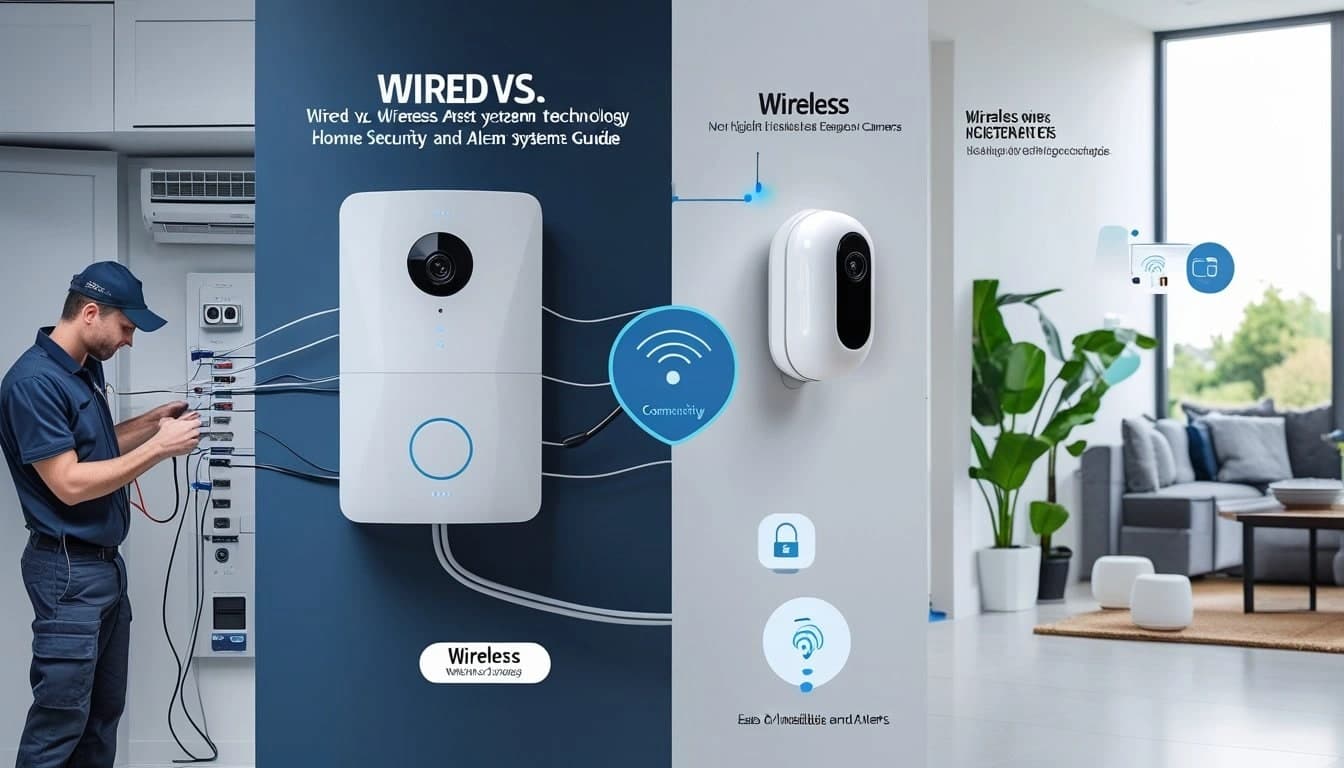
Comparing Wired and Wireless Alarm Systems: Advantages, Disadvantages, and How to Choose the Right One.
When investing in a burglar alarm system , one of the first and most important decisions is choosing between a wired or wireless system. Each technology has its own advantages suited to specific circumstances — there is no single "best" answer for all situations.
This article provides a comprehensive analysis of wired and wireless alarm systems to help you make an informed decision based on your needs and specific circumstances.
Wired Alarm Systems: A Solid Foundation
How It Works
In a wired system, all sensors (doors, windows, motion, smoke, temperature) are physically connected to the control panel using electrical cables—typically 2-core or 4-core cables. Signals travel through the cables, the control panel processes them, and triggers an alarm or sends a warning.
Advantages of Wired Alarms
1. High reliability and stability: Physical connections via cable are not affected by WiFi interference, mobile phone signals, or surrounding electronic devices. The signal is transmitted directly, without passing through the air — therefore, it is much more stable in complex environmental conditions.
2. No worries about running out of battery: The sensors are powered directly via cable — never running out of battery, no need for periodic battery replacements. This is a major advantage for systems with dozens of sensors.
3. Difficult to jam and disrupt signals: Signal jammers cannot disable wired systems because there are no radio signals to jam. This is a significant security advantage against professional thieves equipped with jamming devices.
4. Unlimited bandwidth : Wired systems can support a very large number of sensors (hundreds of points) without worrying about communication bandwidth bottlenecks.
5. Lower maintenance costs in the long run. Once installed, operating costs are very low — no batteries to replace, fewer wear and tear components.
Disadvantages of Wired Alarms
1. Complex and time-consuming installation : Installing wired systems requires drilling walls, routing cables, and technical work. For completed buildings, this causes significant inconvenience and can disrupt the interior aesthetics.
2. Higher initial installation costs: Labor costs, cable materials, and cable routing accessories drive up initial costs, especially for large houses or those with complex layouts.
3. Difficult to expand and modify after installation. Adding new sensors means running more cables — more complicated and expensive than with wireless. Moving offices or renovating the space almost always requires starting over from scratch.
4. Not suitable for leased premises: For shops or offices that are leased, drilling through walls to lay cables is usually not permitted by the landlord. The system also cannot be moved when relocating.

Wireless Alarm Systems: Flexible and Modern
How It Works
Wireless sensors communicate with the control center via radio waves — typically using protocols such as 433MHz, 868MHz (common in Vietnam), Z-Wave (868MHz), Zigbee (2.4GHz), or WiFi (2.4GHz/5GHz). Each sensor has its own battery and signal encryption to prevent interference.
Advantages of Wireless Alarms
1. Quick and minimally disruptive installation. No drilling, no cable pulling — most sensors are attached with double-sided tape or small screws. A 20-point system can be fully installed in a single day.
2. Flexible in layout and expansion: Adding new sensors only requires pairing them with the central unit — no additional installation is needed. Sensors can be easily moved to different locations when adjustments are required.
3. Suitable for leased premises: When the lease ends, the entire system can be easily dismantled and transported to the new location — leaving no marks on the walls.
4. Easy Smart Home Integration: Modern wireless systems integrate seamlessly with Google Home, Amazon Alexa, and Apple HomeKit, allowing for control and monitoring from your phone, in conjunction with cameras and other smart devices.
5. DIY (Do It Yourself) Installation is Possible Many common wireless systems allow users to install them themselves without a technician — ideal for households looking to save on labor costs.
Disadvantages of Wireless Alarms
1. Batteries need periodic replacement. Most wireless sensors use batteries—lasting from 1–5 years depending on the type and frequency of activation. With multi-point systems, battery management becomes a burden without a centralized monitoring system.
2. Risk of Interference: Radio signals can be interfered with by other electronic devices, thick concrete walls, or blocked by specialized jammers. The quality of the manufacturer's encryption protocol greatly affects the ability to resist jamming.
3. Higher equipment costs: Wireless sensors are typically more expensive than comparable wired sensors due to the cost of the radio board and integrated battery.
4. Limit the number of points . Radio bandwidth is limited. Very large systems (hundreds of points) can experience latency or signal interference issues if not carefully designed.

Hybrid Systems: Combining the Advantages of Both
Hybrid systems utilize a central control unit that supports both wired and wireless sensors — the most flexible solution for a wide range of situations:
- Renovation work: Retain the installed wired sensors and add wireless sensors in areas where it is difficult to run cables.
- Phase expansion: Start with a wired system for the main area, expanding with wireless as needed.
- Cost optimization: Use a wire for critical points requiring absolute reliability, and no wire for secondary points.

Cost Comparison: Installation and Maintenance
Category
Stringed
Wireless
Device
Lower
20–40% higher
Installation workers
High (cable installation)
Low (no drilling required)
Total initial cost
Higher than the old building
Lower than the old building
Battery replacement cost
Are not
200,000–500,000 VND/year (multiple locations)
Regular maintenance costs
Short
Medium
Travel costs
Tall (reassemble)
Low (removable and portable)
Comparing Wireless Technologies: Z-Wave, Zigbee, and WiFi
With modern wireless systems, the communication protocol determines the quality:
- Z-Wave (868MHz): Less interference than WiFi, better battery life, supports mesh networks — ideal for high-end smart homes.
- Zigbee (2.4GHz): Fast response speed, supports multiple devices simultaneously, but sharing the same frequency band as 2.4GHz WiFi can cause interference.
- WiFi (2.4GHz/5GHz): No separate hub needed, connects directly to the router — but consumes more battery and depends on the stability of the WiFi network.
- 433MHz/868MHz proprietary: Common in traditional Vietnamese systems — cheap, simple, but with weaker encryption and difficult to integrate with smart home ecosystems.
When Should You Choose a Wired System?
- New construction — construction work begins before interior finishing.
- Long-term residence, no plans to move in 10+ years.
- High security requirements — banks, jewelry, high-value warehouses
- The environment has many electronic devices that cause signal interference.
- Large-scale system with hundreds of sensor points
When Should You Choose a Wireless System?
- The construction is complete, and I don't want to drill through the walls.
- Rental space — shop, office that can be moved
- Quick installation is needed for immediate protection.
- Integration with the smart home ecosystem
- Limited labor budget
Consulting Services for Choosing Alarm Systems from Quang Duc
Choosing the right alarm system depends not only on technology but also on the characteristics of the building, the level of risk, and your long-term goals. Quang Duc Electronics and Telecommunications Co., Ltd. provides both solutions with a team of experienced technicians to advise and implement precisely according to your requirements.
Quang Duc doesn't offer a single solution but analyzes each specific case—from area size, building materials, intended use to budget—to propose the most cost-effective and efficient protection system.
Conclude
Both technologies have a rightful place in the burglar alarm system market. Neither is absolutely perfect — the key is choosing the right one for the right circumstances. If still undecided, a hybrid system is the safest option offering maximum flexibility.
Contact Quang Duc today for free consultation and on-site survey of your project.
Website: cameraquangduc.vn