Guide to Choosing the Right Home Security Camera in 2024
Home security is no longer a luxury. With increasingly affordable prices and advancing technology, installing home security cameras has become a practical decision for millions of Vietnamese households. However, the current market offers hundreds of different product lines — without foundational knowledge, it's easy to choose the wrong one, wasting money or, worse, having a system that doesn't meet actual security needs.
This article provides a step-by-step guide to help you choose the right home security camera —one that fits your budget, home architecture, and practical security goals.
1. Understand Your Needs Before Choosing a Camera
Before considering any specifications, answer the following questions:
- Which area do you want to monitor? Indoors, in the yard, at the entrance, in the garage, or the entire perimeter?
- What is the main objective? To prevent theft, monitor domestic helpers, keep an eye on children, or record evidence in case of an incident?
- What type of house do you have? A multi-story townhouse, an apartment, a single-story house, or a villa?
- Would you like to view it remotely via your phone?
The answers to these questions will determine the appropriate type, number, and placement of cameras.
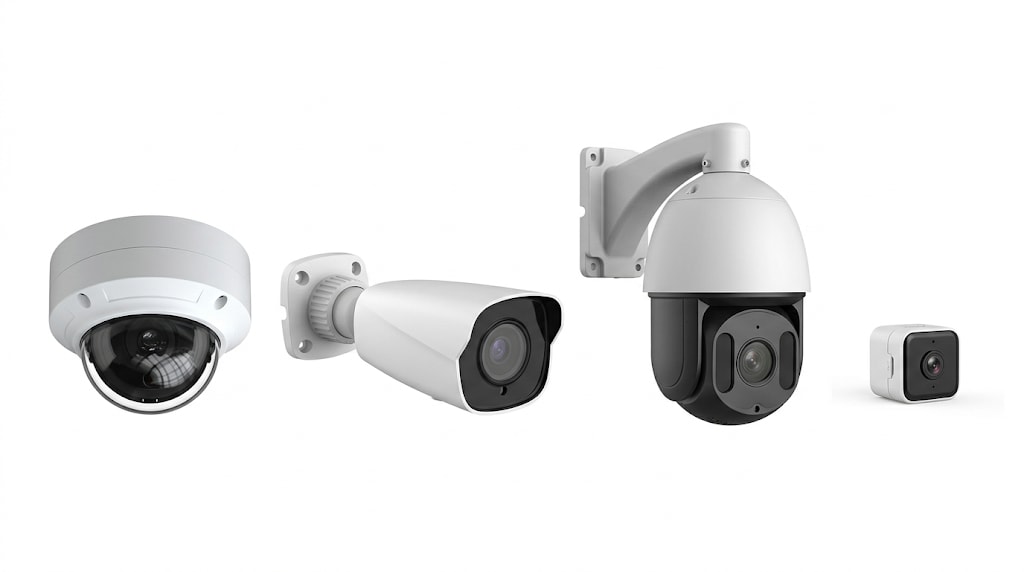
2. Common Types of Surveillance Cameras
Dome Camera (Hemispherical Camera)
Dome cameras have a round design, are mounted on ceilings or walls, and have a lens orientation that is difficult to see from the outside. This is an ideal choice for:
- Indoors: Living room, hallway, entrance area
- Apartment lobby, small office
- The space needs to have a high aesthetic appeal.
Advantages: Compact and aesthetically pleasing, resistant to breakage due to lens protection design, wide viewing angle (usually 100–120°).
Bullet Camera (Cylindrical)
Bullet cameras are long, cylindrical cameras that can be mounted on walls or poles, and are clearly visible from a distance—making them a good deterrent. Suitable for:
- Outdoors: Gates, front yards, parking lots, exterior wall corners
- Area requiring long-distance vision and straight lines.
Advantages: Longer infrared range (30–50m), good water resistance, easy to adjust direction.
PTZ (Pan-Tilt-Zoom) Camera
PTZ cameras can rotate horizontally and vertically and have optical zoom. Suitable for:
- Spacious yard, large garden, villa
- We need to monitor a large area with fewer cameras.
- Includes automatic motion tracking feature.
Disadvantages: Significantly higher price (from 3–10 million VND/camera), requires more sophisticated configuration.
Fisheye Camera (360° Ultra Wide Angle)
A single camera covers the entire room. Suitable for small warehouses, shops, and children's rooms. The drawback is that the image is distorted at the edges and requires de-warping software.
3. Resolution — How Much Is Enough?
Resolution directly affects the ability to recognize faces, license plates, and details in videos.
Resolution
Quality
Suitable for
2MP (1080p Full HD)
Good
At home, limited budget.
4MP (2K)
Very good
Most families prioritize a cost-quality balance.
8MP (4K Ultra HD)
Excellent
Outer gate, clear license plate/face recognition required.
Practical recommendation: For typical townhouses, 4MP is the sweet spot — sharp enough for facial recognition at 5–8m without consuming excessive storage space. 8K (4K) cameras should be used at the main entrance or key points requiring detailed recognition.
4. Important Features to Check
Night Vision Infrared
Most modern cameras have infrared LEDs for night vision. Note:
- Minimum infrared range: 20m for indoor cameras, 30–50m for outdoor cameras.
- Full-color night vision: Some high-end cameras use large sensors plus white-light illumination to capture color at night — resulting in more natural and easily recognizable images.
- Starlight sensor: Special sensor technology that captures color in extremely low light conditions without the need for supplemental lighting.
Motion Detection
A basic feature of all modern cameras. When motion is detected, the camera will:
- Send push notifications to your phone.
- Start recording (instead of recording continuously — saves storage)
- Activate the warning lights or siren (if integrated).
More advanced cameras can even distinguish between people, vehicles, and pets to reduce false alarms.
Two-Way Audio
Allows you to listen and talk through the camera on your phone. Useful for:
- Communicate with the delivery person when you are away from home.
- Intruder alert
- Contact children or family members at home.
Water and Dust Resistant (IP Rating)
- IP65: Splash-proof — suitable for most covered outdoor locations.
- IP66/IP67: Rainproof, perfectly suitable for outdoor use.
- Indoor cameras typically don't need a high IP rating.
5. Wired Cameras vs. Wi-Fi Cameras
Wired/PoE Camera
Transmit signals via network cable or coaxial cable. Advantages:
- Stable connection, no signal interference.
- No worries about running out of battery or losing Wi-Fi connection.
- Stable image quality, low latency.
- Suitable for multi-camera systems (4–16 cameras)
Disadvantages: Requires wiring — difficult to install in a finished house, higher labor costs.
Wireless WiFi Camera
Connect via your home Wi-Fi network. Advantages:
- Quick installation, no complicated wiring required.
- Flexible to move and install in various locations.
- Low construction costs
Disadvantages: Dependent on Wi-Fi signal quality, prone to disconnections if the router is weak, not suitable for large systems.
Suggestions for Vietnamese townhouses: Use Wi-Fi cameras for 1-2 points inside the house (bedroom, children's room). Use wired/PoE cameras for a full system of 4-8 cameras covering the entire exterior.
6. Data Storage — NVR, DVR, and Cloud
NVR (Network Video Recorder) — For IP Cameras
Centralized video recording device for IP (digital) camera systems. Records video to an internal HDD. Advantages:
- Local storage, not internet-dependent.
- Large storage capacity (1–4TB depending on configuration)
- Review footage quickly and smoothly.
Note: A dedicated hard drive for cameras (WD Purple, Seagate SkyHawk) is required — do not use a regular computer hard drive.
DVR (Digital Video Recorder) — For Analog Cameras
Similar to NVR but designed for coaxial cable (analog/AHD) camera systems. Common in systems installed before 2018. Currently, the trend is shifting towards IP cameras + NVR.
Cloud Storage
Several companies (Hikvision, Dahua, Reolink, Tp-Link Tapo) offer cloud storage services on a subscription basis. Advantages:
- Data remains secure even if the camera is stolen or the NVR is destroyed.
- Easy remote access
Disadvantages: Monthly cost, requires a stable internet connection, privacy concerns.
Optimal solution: Combine on-premise NVR + cloud backup for critical cameras.

7. Reference Budget for Vietnamese Families
Scale
Number of cameras
Configuration
Estimated cost
Small (apartment, boarding house)
2–3 Wi-Fi cameras
2MP–4MP, memory card/cloud storage
2–5 million
Average (3-4 story townhouses)
4–6 IP cameras
4MP + 4-channel NVR, 1TB HDD
8–15 million
Large (villa, spacious house)
8–16 cameras
4MP–8MP + 8/16-channel NVR, 2–4TB HDD
20–50 million
The price includes equipment and installation labor, but excludes PTZ cameras or AI features.
8 Practical Tips for Vietnamese Townhouses
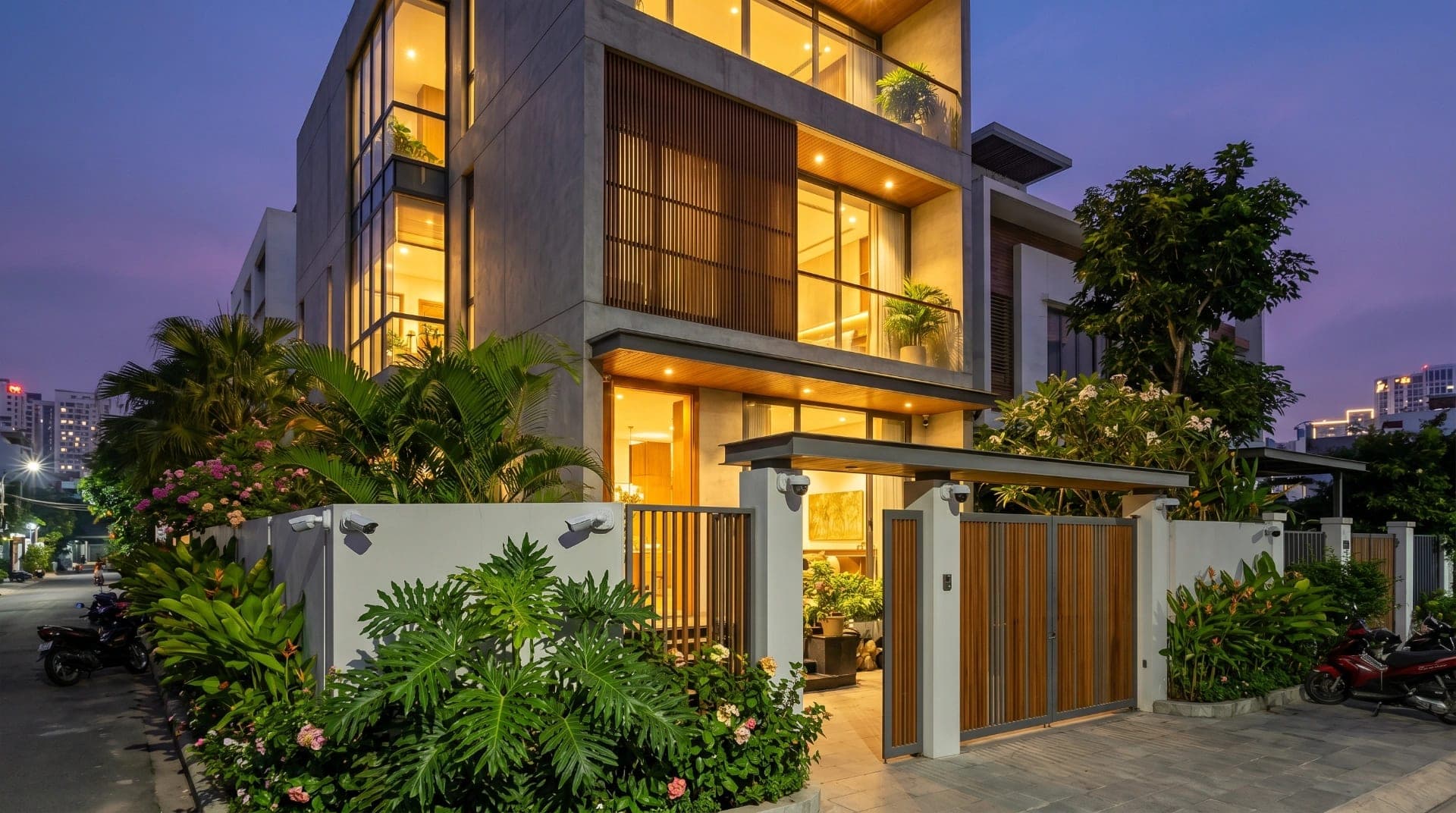
Vietnamese townhouses have unique characteristics: narrow width (4–5m), multiple floors (3–5 floors), vertical staircases, and a small alley at the back. Some things to note:
- Front gate: Position a 4K/8MP camera facing the street, with sufficient field of view to read license plates.
- Ground floor (garage/shop): 1 dome camera providing a panoramic view, 1 camera pointed at the staircase.
- Each floor hallway: 1 small dome camera sufficient to cover the narrow hallway.
- Rooftop/Rooftop: IP66 waterproof camera, pointed towards the roof access and surrounding area.
- Back alley/lane: Small bullet camera mounted high, providing a comprehensive view of the alley.
For a four-story townhouse, typically 6–8 cameras are needed for adequate coverage.
Consultation and Installation of Surveillance Cameras in Quang Duc
Choosing the right camera is just the first step — proper installation, system configuration, and ensuring a stable connection are the key factors determining its effectiveness. Quang Duc Electronics and Telecommunications Co., Ltd. , with many years of experience in the surveillance camera field, will help you:
- Free on-site survey and consultation to find solutions that fit your budget.
- We provide and install complete packages from reputable brands: Hikvision, Dahua, and Kbvision.
- Equipment warranty and post-installation technical support.
- Instructions for using the remote camera viewing app.
Contact Quang Duc at cameraquangduc.vn today for free consultation and detailed pricing for your home security camera system.