Corporate Event Hall Sound System: Professional Design
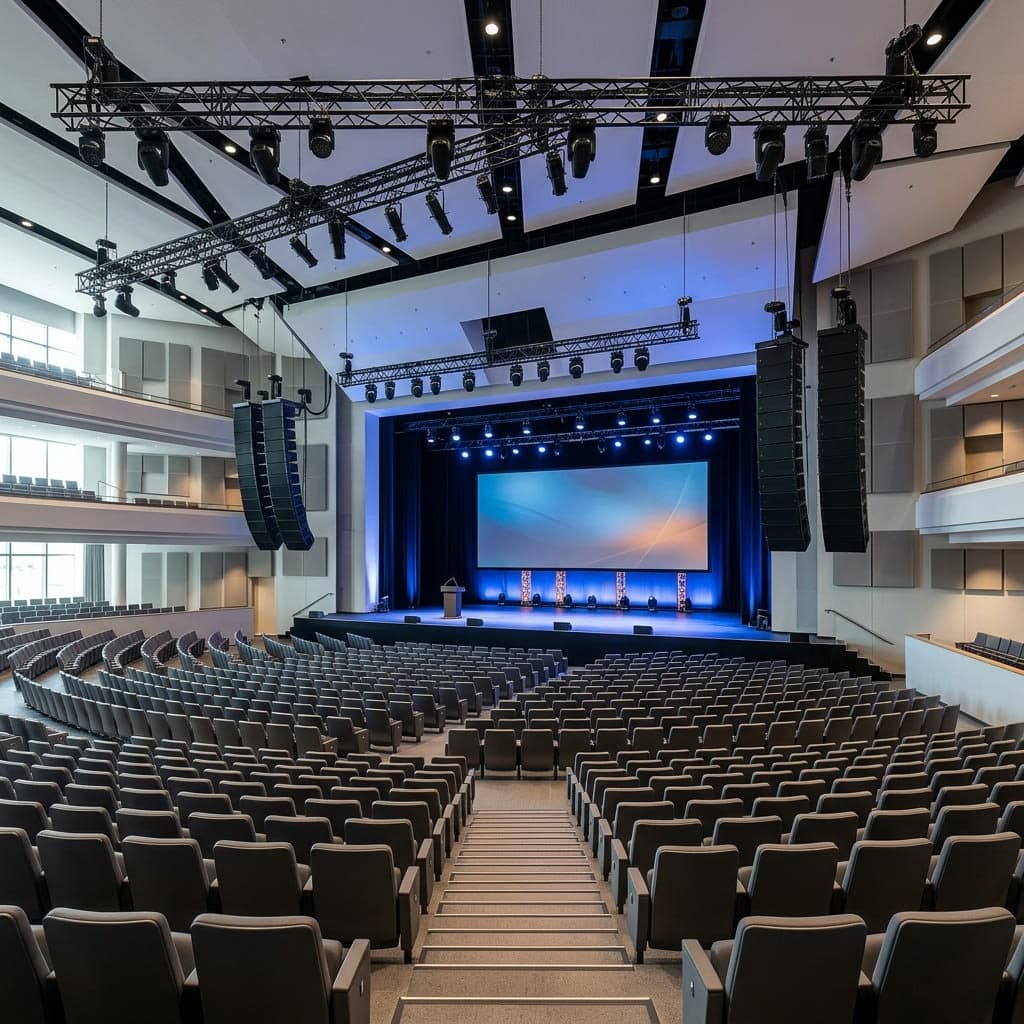
A 500-seat corporate auditorium hosting an anniversary celebration, customer conference, or shareholder meeting requires a sound system that meets stringent requirements: the presenter's voice must be clear to the back rows, and the background music and stage effects must be powerful without being jarring to the front rows. Based on practical experience, a standard auditorium sound system for a 300-500 seat capacity costs between 300 million and 1.2 billion VND, depending on the equipment configuration and the level of integration with lighting and visuals.
This article analyzes the core components of a corporate event hall sound system — from speaker selection, amplifier power, mixer control, wireless equipment to acoustic acceptance standards — providing businesses with a basis for working effectively with construction companies.
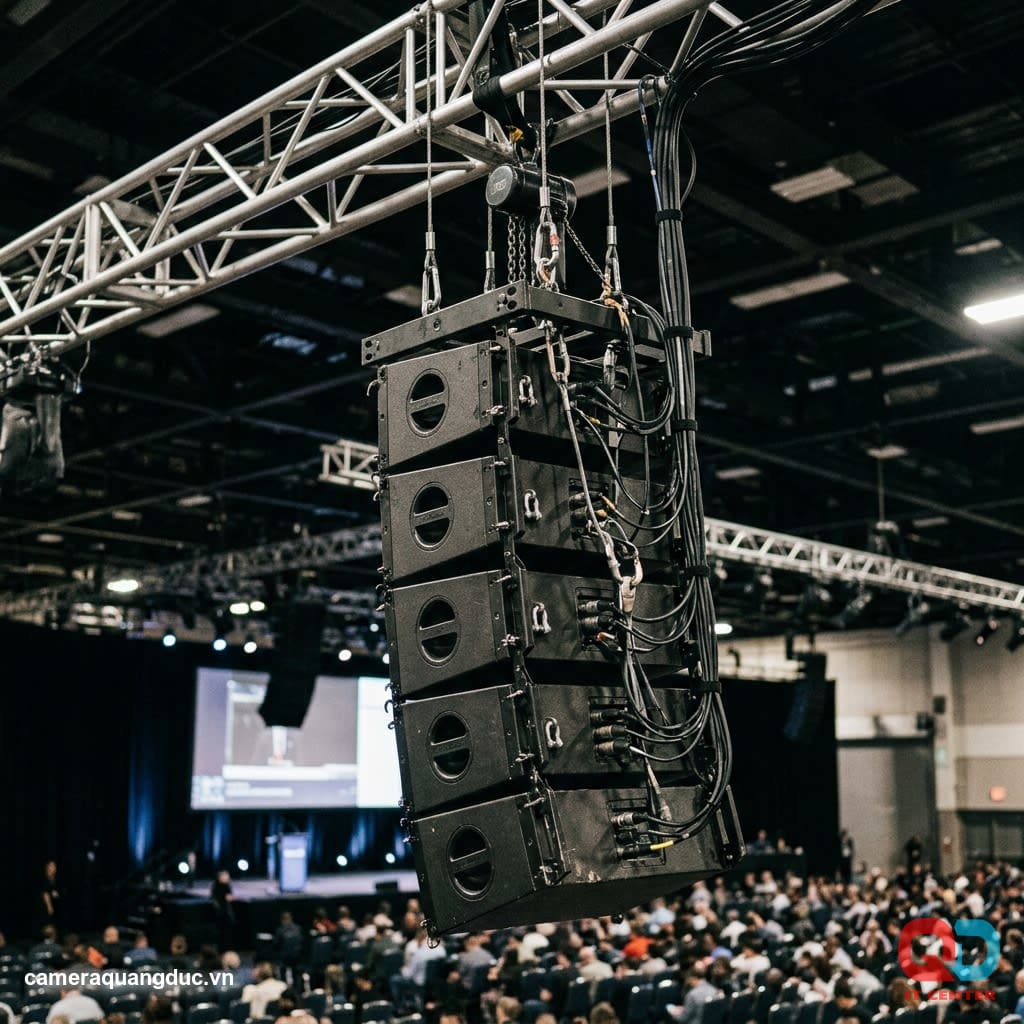
Line Array vs. Point Source: Which is Right for Your Auditorium?
Point Source — Solutions for Small Spaces
Point source is a traditional speaker configuration, where each speaker cabinet acts as an independent sound source, usually suspended on either side of the stage. It's suitable for venues with fewer than 200 seats, has lower investment costs, and is easy to install and dismantle when needing to move equipment between events.
Line Array — Required for Large Auditoriums
A line array is a cluster of many small speakers arranged vertically in a system, creating cylindrical sound waves that help the sound spread evenly along the length of the room instead of attenuating according to the square law of distance like a point source. For auditoriums with over 300 seats or spaces deeper than 25m, a line array is almost a mandatory choice to ensure that those in the back rows can hear as clearly as those in the front rows.
Criteria
Point Source
Line Array
Appropriate scale
Under 200 seats
300-1000+ seats
Sound uniformity across depth
Rapid decline towards the end of the room.
Uniform, deviation less than 3dB
Investment costs
40-50% lower
For higher elevations, careful calculation of the coverage angle is necessary.
Installation time
Fast, 2-4 hours
Rigging is required, including calculations for suspension, which will take 1-2 days.
Construction technical requirements
Simple
Requires experienced sound engineers.
18-Inch Subwoofer: Powering Up Event Sound
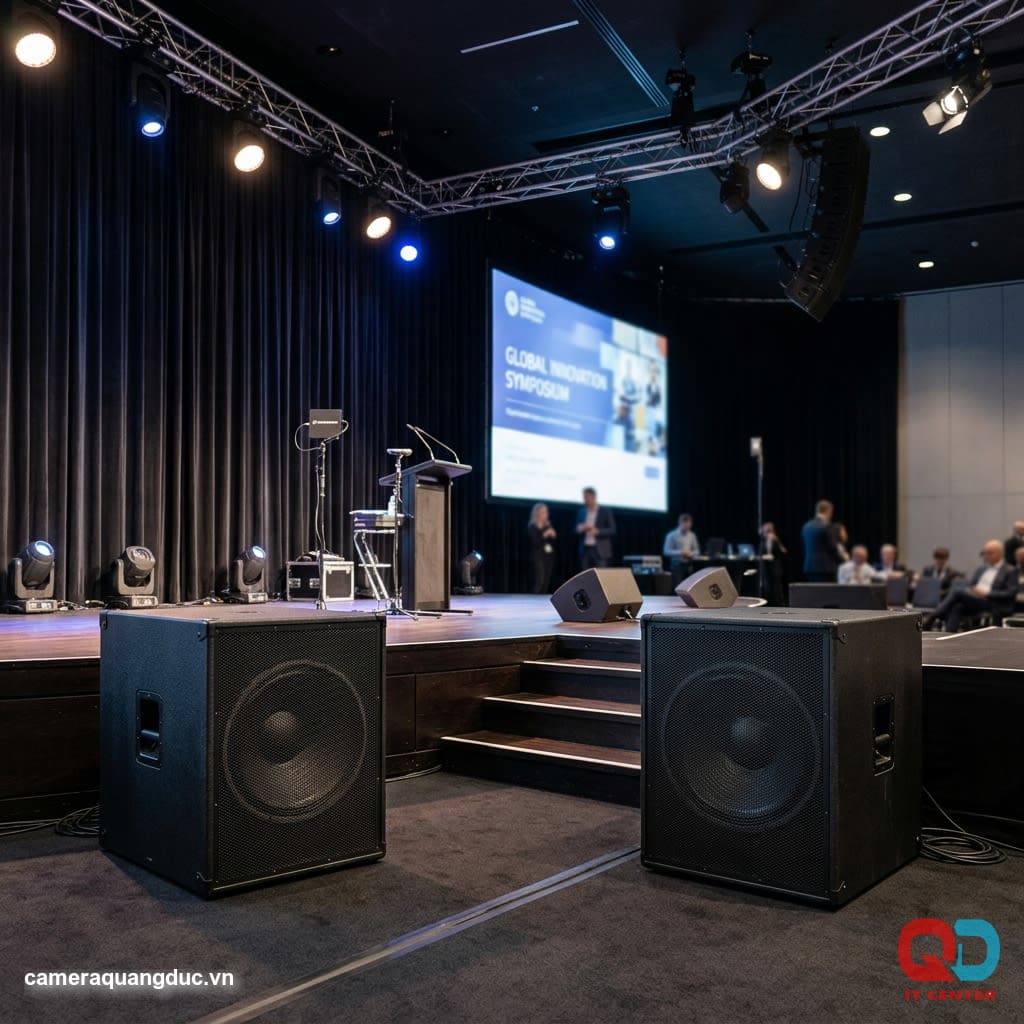
Subwoofers reproduce low frequencies (below 100Hz) that full-range speakers don't handle well — adding a sense of "power" to opening music, stage effects, and dramatic segments in a show. An 18-inch driver is the most common size for corporate auditoriums due to its balance between bass depth and manageable enclosure size.
Subwoofer placement principles:
- Place the stage panels close to the floor on either side or in the middle to take advantage of the floor's resonance effect.
- For auditoriums with over 500 seats, consider a cardioid configuration (subwoofers positioned out of phase) to reduce bass reflections towards the stage and avoid microphone feedback.
- Common ratio: 1 pair of subwoofers for every 150-200 seats
Class D Amplifiers and Digital Mixers: The Brain Controlling the System
Amplifier Power: 2000W to 8000W
Class D amplifiers are favored for their high power conversion efficiency (over 90%), low heat dissipation, and lighter weight compared to traditional Class AB amplifiers. The required power depends on the number and type of speakers.
- For a hall with 200-300 seats: a total power amplifier of 2000-3000W is required.
- For a hall with 300-600 seats: a total power amplifier of 4000-6000W is required.
- For auditoriums with over 600 seats: a total power amplifier of 6000-8000W is required, usually with multiple independent channels for line array and subwoofer.
Digital Mixers: Yamaha QL and Allen & Heath SQ
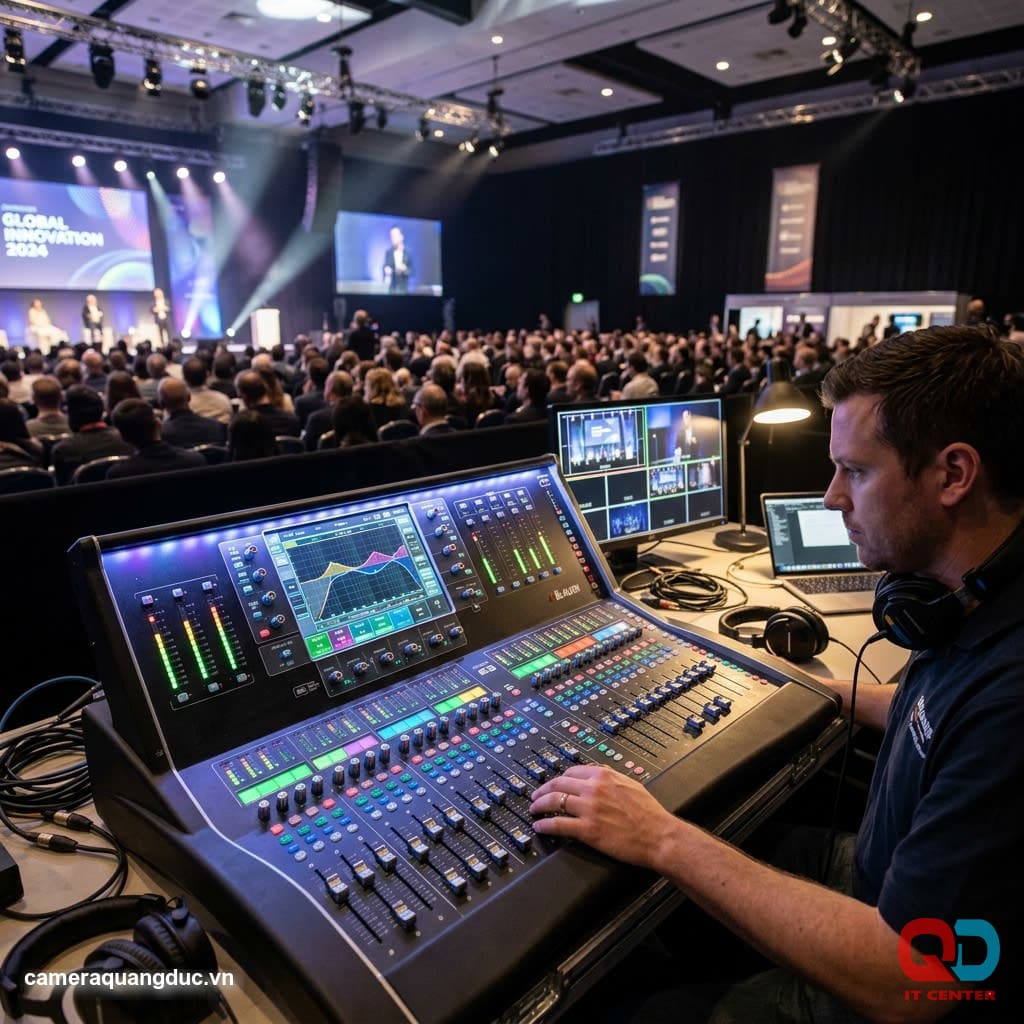
A digital mixer is the central processing and routing unit for audio signals, completely replacing traditional analog mixers thanks to its ability to save presets, integrated EQ/compressor processing, and remote control via tablet.
- Yamaha QL Series: Intuitive interface, powerful DSP ecosystem, popular among professional event equipment rental companies.
- Allen & Heath SQ Series: Compact, high-quality signal processing, suitable for fixed corporate meeting rooms requiring simple operation and minimal technical personnel.
UHF Wireless Microphones: 4-8 Channels for Conferences
Corporate meeting rooms often require multiple active microphones simultaneously: handheld microphones for the MC, lapel microphones for speakers, and desk microphones for delegate presentations. A 4-8 channel UHF system from Shure or Sennheiser ensures:
- Stable operating frequency, minimal interference with Wi-Fi devices and mobile phones in the room.
- Reliable reception range within a radius of 30-50m.
- The ability to synchronize multiple channels without overlapping frequencies via automatic scanning feature.
Checklist for preparing microphones for a hall event:
- Determine the number and type of microphones needed (handheld, lapel, desktop).
- Check that the battery is fully charged, and have a spare battery.
- Scan the frequency at the event venue before the event begins.
- Testing the actual signal reception range in a hall setting.
- Prepare a backup microphone in case of an unexpected incident.
Acoustic Testing Standards: Reverb Time and SPL
Reverb Time: Under 1.5 Seconds
Auditoriums with hard surfaces (glass, concrete, brick) are prone to sound reflections before fading completely, causing speech to become muffled and difficult to hear. A good standard for presentation/conference halls is a reverb time (RT60) below 1.5 seconds . If measured above this level, additional sound-absorbing materials (sound-absorbing panels, curtains, carpets) should be added to surfaces with strong reflections.
Uniform SPL measurement of 95dB throughout the entire hall.
Sound Pressure Level (SPL) is a measure of the actual sound intensity at different seating positions. A good acceptance standard requires that the SPL measured at various points in the auditorium (front, middle, back, sides) does not differ by more than 3dB from the average 95dB when the standard test signal is played — ensuring a consistent listening experience regardless of seating position.
Measurement location
Target SPL
Acceptable deviation
Front row seats
92-98dB
±3dB
In the middle of the hall
92-98dB
±3dB
Back row
92-98dB
±3dB
Both wings
90-96dB
±3dB
Quang Duc's Sound System Services for Conference Halls and Events
Quang Duc Electronics and Telecommunications Co., Ltd. provides comprehensive sound solutions for corporate events and auditoriums :
- Survey and measure the acoustic parameters of the auditorium and advise on a suitable line array/sub bass configuration.
- We supply genuine equipment: digital mixers, Class D amplifiers, UHF wireless microphones.
- Rigging and speaker mounting are installed safely and meet technical standards.
- SPL and reverb time measurements are taken for acceptance testing after installation.
- Providing technical operational support for large corporate events.
Quang Duc has partnered with numerous businesses to organize conferences, celebrations, and important events, ensuring professional sound quality from design to actual operation.
Event Day Operating Procedure
Soundcheck
A professional event management process always allocates at least 2-3 hours before the event for a comprehensive soundcheck: checking each microphone channel, test-running background music through the entire line array and subwoofer, and re-measuring SPL at several representative locations to confirm the system meets standards before guests arrive.
Event Technical Team
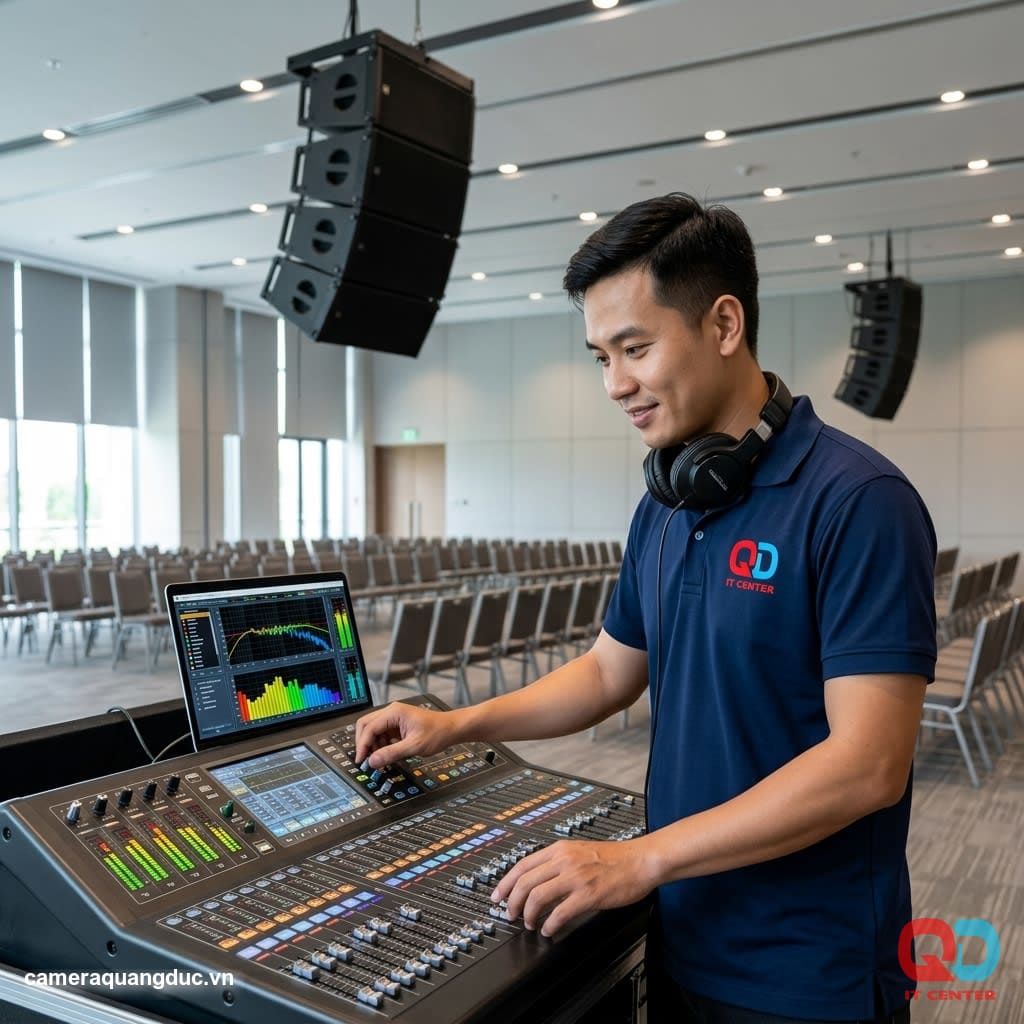
For a hall with over 300 seats, it's advisable to have at least 1-2 sound technicians stationed at the mixer throughout the event to promptly handle any issues that may arise, such as microphone static, unexpected feedback, or the need for flexible volume adjustments as the program progresses.
Event operation checklist:
- Soundcheck the entire system at least 2 hours before the event.
- Check the battery and frequency of the entire wireless microphone.
- Measure SPL at 4-5 representative locations in the hall.
- A technician will be stationed at the mixer console throughout the program.
- Prepare backup equipment (microphone, cable, antenna) for emergencies.
Integrated with Lighting and Projection Systems
Modern corporate meeting rooms typically don't operate with separate sound systems but instead integrate them seamlessly with stage lighting and image projection systems via a common timecode. This synchronization allows for:
- The background music automatically matches the lighting effects according to the pre-set program script.
- The transitions between segments are smooth: opening, speeches, intermission, closing.
- Reduce reliance on manual operations and minimize human errors during program execution.
An experienced multi-system integration contractor will help businesses save significant setup time for recurring events such as annual conferences.
Conclude
A standard auditorium sound system isn't just about buying high-powered equipment; it's a combination of appropriately sized speakers, a precise mixer-amplifier configuration, and rigorous acoustic testing before use. Investing wisely from the start helps businesses avoid having to renovate the system after a few unsuccessful events.
If your business is planning to build or upgrade a meeting hall, contact us for a survey and consultation to determine the most suitable sound system for your space and intended use.
From acoustic design to on-site operation on event day, a reliable technical partner will allow businesses to focus on the program content instead of worrying about sound quality.
Hotline: 0903 306 126 (Mr.Vũ Trần) | Website: cameraquangduc.vn