Fiber Optic Cable Installation Project for Industrial Zones: Practical Implementation Experience
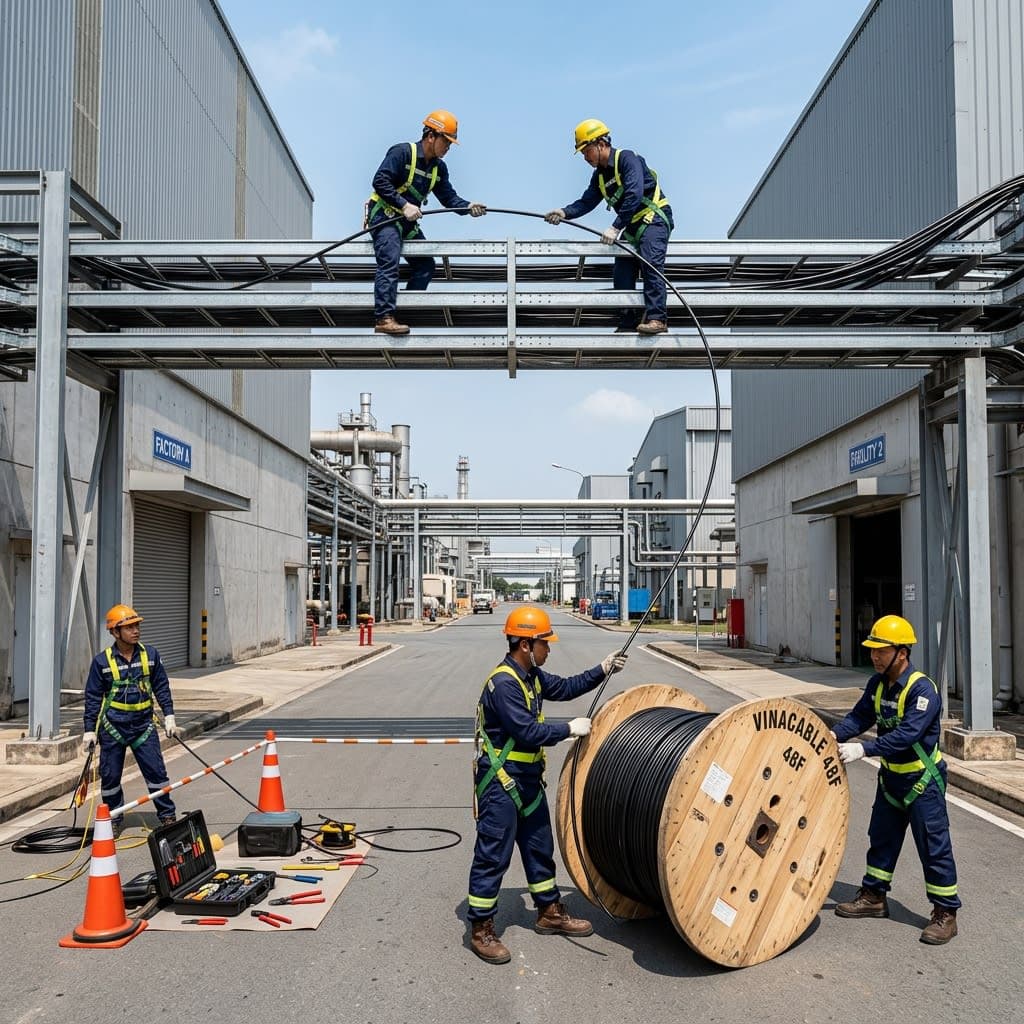
An industrial park with 12 manufacturing plants, totaling over 18 hectares, had been operating on outdated copper cable infrastructure for over 10 years — with a maximum data transmission speed of only 100 Mbps between the plants, and frequent connection interruptions due to electromagnetic interference from production lines and mold growth over time. This was the real-world scenario of the fiber optic cable installation project that Quang Duc's technical team implemented in the recent quarter, involving over 5km of main fiber optic cable and 45 days of construction.
This article shares the practical experience of implementing a fiber optic cable installation project for an industrial park — from initial surveys and construction challenges in an operating production environment to the measurable results after completion, providing valuable insights for other industrial park businesses when planning network infrastructure upgrades.

Project Background and Scope
Current Status Before Deployment
The industrial park comprises 12 manufacturing plants and a central administrative office area, utilizing CAT5 copper cable infrastructure installed over a decade ago. Remaining issues include:
- The maximum inter-factory connection speed of 100 Mbps is insufficient to meet the data transmission needs of the newly installed AI camera system and IoT machinery.
- On average, there are 3–4 disconnections per month due to electromagnetic interference from high-powered motors in the production workshop.
- The distance between some workshops and the central server room exceeds 100m — the technical limit of standard Ethernet copper cable.
- Insufficient spare bandwidth for the ERP system expansion plan and centralized production monitoring.
Project Implementation Scale
Category
Actual specifications
Total length of the main fiber optic cable
Over 5,000 meters (24FO single-mode fiber optic cable)
Number of connected factories/buildings
12 workshops + 1 administrative office area
Number of optical distribution points (ODF)
13 ODF cabinets are installed in each factory.
Optical-to-electrical converter (Media Converter/Optical Switch)
26 double-ended devices
Actual construction time
45 days (on schedule as committed)
Construction engineering team
6–8 technicians, divided into 2 shifts.
Practical Challenges During Construction
Construction in an Operating Production Environment
The biggest challenge of the project was maintaining continuous production in the factories throughout the construction period — it was impossible to halt the production line to lay cables. The solution implemented:
- Conduct a detailed survey of existing cable routes (conduit, cable tray) to reuse existing underground infrastructure and minimize excavation.
- Schedule construction work during night shifts and production breaks in areas near the production line.
- Use electromagnetic interference (EMI) shielding conduit for cable runs near motors and high-power electrical cabinets.
- Coordinate closely with the industrial park's occupational safety department and adhere to the procedures for entering and exiting the production area.
Handling Terrain and Long Distances
With some workshops located up to 800m from the central server room, the construction team did the following:
- Use single-mode fiber optic cable instead of multi-mode to ensure stable signal transmission over long distances (single-mode can transmit up to 10–40km without significant loss).
- Fiber optic cables are spliced at intermediate connection points using specialized fiber optic fusion splicers, ensuring splice loss is below 0.05dB.
- Perform a full-line OTDR (Optical Time Domain Reflectometer) test before connecting terminal equipment to detect potential faults.
Ensuring Safety in Areas at Risk of Fire and Explosion
Some factories belong to industries with strict fire safety requirements (chemical warehouses, metal welding and cutting areas). The construction team complied with these requirements:
- Use flame-retardant fiber optic cables (LSZH - Low Smoke Zero Halogen) for sections passing through sensitive areas.
- Obtain a hot work permit when drilling or cutting is required in areas with a risk of fire or explosion.
- Fully equip the construction site with mobile fire fighting equipment as required by regulations.
Project Implementation Process Checklist

- Survey the current infrastructure and measure the actual distances for each route.
- Design the fiber optic network topology and determine the placement of the ODF cabinet.
- Develop a shift-based construction schedule and coordinate the production schedules of each factory.
- Cable laying, splicing, installation of ODF cabinets and fiber optic converters.
- Full-line OTDR testing, attenuation and signal quality checks.
- Connect terminal equipment, configure switches, and test inter-factory connectivity.
- Handover, operational training, and provision of as-built documentation.
- Warranty and post-deployment technical support
Results Achieved After Implementation
After 45 days of construction and commissioning, the new fiber optic cable system has brought about significant improvements compared to the old copper cable infrastructure:
Index
Before deployment
After deployment
Inter-factory connection speed
100 Mbps
1 Gbps (10x increased capacity, stable actual usage at 800 Mbps)
Number of disconnections/month
3–4 times
Less than once per quarter (a reduction of approximately 95%)
Maximum connection distance
Limit of 100m (copper cable)
Up to 800m with no significant signal loss.
Scalability of AI/IoT camera systems
Bandwidth limitations
Ensure sufficient bandwidth is available for the next 5 years.
Construction downtime
—
Almost zero thanks to construction work being done in shifts outside of regular production hours.
The industrial park management board assessed that the project has thoroughly resolved the long-standing network congestion problem and created a solid infrastructure foundation for the next phase of the production management digitalization plan.

Lessons Learned from the Project
Thorough Survey Before Providing a Quote Is a Key to Success
Errors in the initial survey (distance, obstacles, condition of underground conduit) can cause actual costs to exceed the initial estimate by 15–20%. Quang Duc Construction Team applies a two-round survey principle — Round 1: an overview for preliminary pricing, Round 2: a detailed survey of each connection point before signing the official contract.
Fiber Optic Backup for Future Expansion Needs
Instead of installing just the number of fiber optic cables needed immediately, the project used 24FO cables instead of 12FO, even though the current need was only 8-10 fibers. This was to provide for the planned expansion of AI cameras and IoT production monitoring systems over the next 5 years without having to redo the entire installation.
Closely coordinate with the Industrial Park Management Board.
Each industrial park has its own safety regulations, entry and exit times, and construction permit application procedures. Coordinating early with the management board helps avoid delays caused by administrative procedures arising midway through the project.
Checklist for lessons learned for future projects:
- Always conduct two rounds of site surveys before finalizing the contract and timeline.
- Ensure a minimum of 50% of the fiber optic cables are reserved compared to current demand.
- Develop a shift-based construction schedule and notify each factory at least 48 hours in advance.
- Prepare contingency plans in case of bad weather or unforeseen incidents.
- Maintain complete OTDR test records as a basis for future warranty claims.
Quang Duc's Fiber Optic Cable Installation Services for Industrial Zones
Quang Duc Electronics and Telecommunications Co., Ltd. has experience in deploying fiber optic infrastructure for many large-scale industrial parks and factories.
- Survey and design the optimal fiber optic cable route diagram for the actual terrain and production scale.
- Flexible shift-based construction ensures no disruption to our clients' production operations.
- Signal quality is measured using specialized OTDR equipment, ensuring compliance with international technical standards.
- Provide complete project completion documentation, warranty support, and regular maintenance after implementation.
- Consulting on bandwidth redundancy solutions for future expansion plans of AI and IoT camera systems.

Reference Costs for Similar Projects
Category
Estimated cost (VND)
24FO (5,000m) single-mode fiber optic cable
350–450 million VND
ODF cabinets and connection accessories (13 cabinets)
65–90 million VND
Photoelectric converters (26 units)
80–120 million VND
Construction workers, welders, and inspectors.
90–130 million VND
OTDR testing and acceptance
15–20 million VND
Estimated total cost for a project of similar scale
600–810 million VND
Actual costs may vary depending on the terrain, distance, and specific technical requirements (fire-resistant cables, electromagnetic interference shielding) of each industrial park.
Factors that Increase or Decrease Project Costs
- Increased costs: Complex terrain requiring new underground excavation instead of reusing old conduit, demanding specialized fire-resistant cables, and construction being rushed beyond the planned schedule.
- Reduced costs: Leverage existing conduit infrastructure, flexible construction schedules without the need for urgent overtime, and large-scale material orders under long-term contracts.
Post-Deployment Warranty Policy
Category
Warranty period
Fiber optic cables and ODF cabinets
24 months
Photoelectric converter
12–24 months depending on the manufacturer.
Optical splice and signal quality
12 months, free re-testing if any errors occur.
Conclude
This fiber optic cable installation project for the industrial park demonstrates that upgrading network infrastructure doesn't necessarily have to come at the cost of production disruptions, if it's carefully planned and executed by a team with practical experience. The results, showing a tenfold increase in network speed and a 95% reduction in connection disruptions, demonstrate that investing in fiber optic infrastructure is a sound decision for industrial parks undergoing the digitalization of their production processes.
If your business is facing similar problems with its outdated network infrastructure, contact Quang Duc for a survey and consultation on a suitable deployment plan.
Hotline: 0903 306 126 (Mr.Vũ Trần) | Website: cameraquangduc.vn