
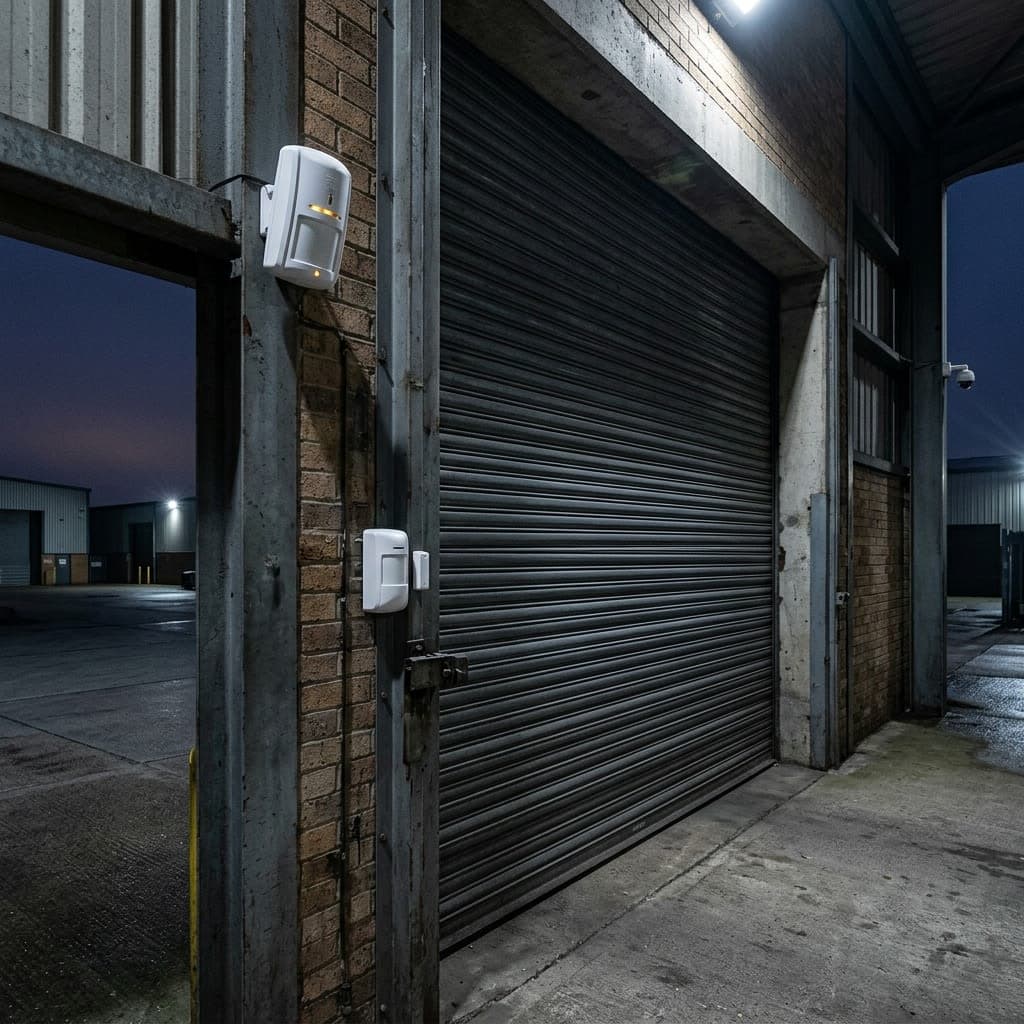
Wireless Anti-Theft Alarm System for Factories and Warehouses
According to statistics from business property insurance companies, over 65% of burglaries at factories and warehouses occur between 0:00 and 5:00 AM when no one is on duty. Surveillance cameras can record images but cannot prevent theft once it is happening — that's why burglar alarm systems have become an indispensable proactive layer of protection.
This article introduces a wireless alarm solution for factories and warehouses — from sensor principles and signal transmission frequencies to effective false alarm prevention configuration.
Why Do Factories and Warehouses Need Their Own Alarm Systems?
Security cameras record evidence after an incident has occurred, while alarm systems detect and alert immediately upon intrusion — reducing response time from hours (when reviewing camera footage) to seconds.
Specific risks of factories and warehouses
- Large area, multiple entry and exit points: main door, side doors, windows, corrugated iron roof — many vulnerable points requiring simultaneous monitoring.
- Long periods without on-duty personnel: Nighttimes, weekends, and holidays are the times of highest risk.
- High-value goods: Raw materials, finished products, machinery and equipment are of high value and easily become targets.
- Old building structure: Many factories were built a long time ago, making concealed wiring expensive and difficult to install.
Wireless systems directly solve the final problem — allowing for quick installation without the need to drill through walls or concrete floors.
Types of Sensors in Wireless Alarm Systems
PIR (Passive Infrared) sensor
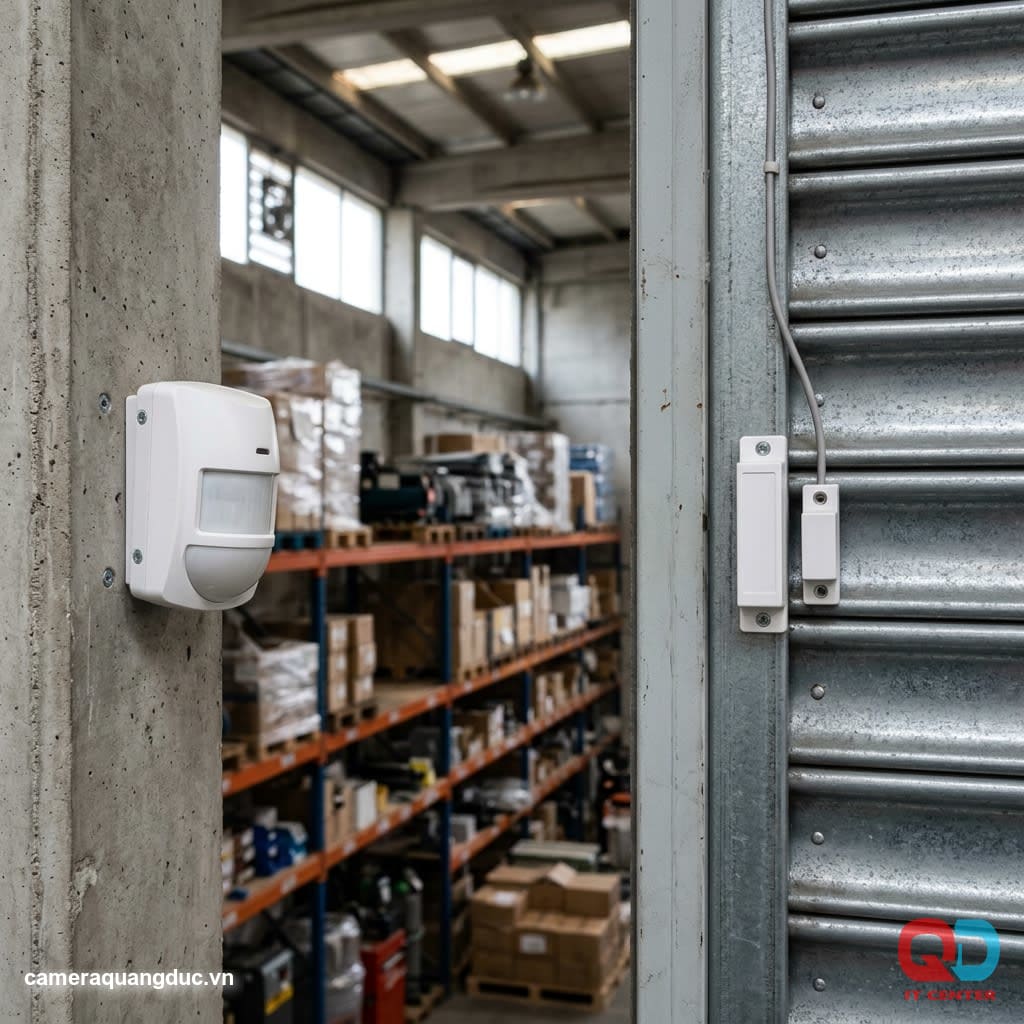
PIR sensors detect motion based on changes in infrared heat emitted from the human body within the scanning area. This is the most common type of sensor, installed in factories to monitor large areas.
- Scanning range: Typically 8–12m, scanning angle 90–110°
- Ideal installation location: Corner of a room, hallway, storage area with main access.
- Pet-immune type: Features a specialized PIR sensor that ignores the movement of small animals under 25kg, suitable for factories with guard dogs.
Door/Window Contact Sensor
It consists of two parts: a magnet attached to the door and a sensor attached to the door frame. When the door opens, the magnetic circuit is broken and the alarm is triggered immediately—detecting the intrusion at the point of entry before the burglar gets further inside.
Glass Break Detector
It identifies the characteristic sound frequency when glass is shattered, making it suitable for installation in areas with glass windows, glass partitions in offices and factories.
Vibration/Shock Sensor
Attach it directly to roller doors and warehouse metal doors — it detects attempts at prying or drilling before thieves successfully gain entry.
Signal Transmission Frequency: 433MHz and 868MHz
Wireless alarm systems transmit signals from sensors to a central hub via RF radio waves. Choosing the correct frequency directly affects the system's stability and interference resistance.
Criteria
433MHz
868MHz
Transmission distance (without obstacles)
100–150m
200–300m
Ability to penetrate obstacles (walls, metal)
Medium
Better
Device popularity
Very popular, low cost
Less common, higher price
Risk of signal interference
Higher frequency (more devices sharing the same frequency band)
Lower (less occupied frequency band)
Suitable for
Small and medium-sized workshops with few metal obstacles.
Large factory, many steel structures, far apart.
Recommendation: For factories with steel frame structures, thick corrugated iron roofs, or areas exceeding 2,000m², the 868MHz system is preferred to ensure stable signals between sensors and the central hub.
Central Hub: The Brain of the Alarm System
The central hub (control panel) receives signals from all wireless sensors, processes them, and triggers alerts via sirens and flashing lights, while also sending notifications to the business owner.
Essential features for a factory hub.
- Supports connecting a minimum of 30–50 wireless sensors (suitable for multi-zone factories).
- Integrated backup 4G SIM card — continues to function even when internet/Wi-Fi connection is lost.
- Backup battery provides at least 12–24 hours of power outage protection.
- Connect to the phone app to turn the sensor on/off and view its status remotely.
- Independent zones — it's possible to activate a portion of the area while another area remains operational.
- Event logs must be stored for a minimum of 30 days for easy retrieval when needed.
Integrating SMS and Mobile App: Instant Alerts
Modern alarm systems not only sound an alarm locally but also send alerts directly to the business owner's or security team's phone, even when they are far from the scene.
Standard alert procedure
- Intrusion detection sensor → sends a signal to the central hub.
- The hub activates the siren and flashing lights on the spot for immediate deterrence.
- Simultaneously send SMS and push notifications via the app to the registered phone number.
- The app accurately displays which sensor is activated, the time, and includes images from the linked camera (if integrated).
- The business owner can call the security guard to confirm or report the incident to the local police immediately.
Note: It is recommended to register at least 2–3 phone numbers to receive alerts (business owner, shift manager, security guard on duty) to ensure someone is always available to handle issues promptly.

Backup PIN and Noise Reduction: Ensuring System Uptime
Professional burglars often try to disable alarm systems before breaking in—cutting off the power, jamming the Wi-Fi signal. A quality alarm system needs layers of protection against these very tactics.
System protection measures
- Backup battery at each sensor: Wireless sensors operate on their own batteries (usually 3V lithium batteries, with a lifespan of 2–3 years), and are not dependent on mains power.
- Backup battery at the central hub: Maintains operation for 12–24 hours during a power outage.
- Backup 4G SIM: Automatically switches to cellular connection when internet access is cut off.
- Tamper alert: The system automatically alerts you if someone attempts to remove or damage the sensor/hub.
False Alarm Prevention: Configure It Right From the Start.
Frequent false alarms are not only annoying but also cause business owners and security guards to become desensitized, ignoring real alarms when they occur.
Common causes of false alarms and how to fix them.
Reason
Solution
Insects and spiders fly past the PIR sensor.
Clean the sensors regularly, and choose insect-resistant sensors.
Small animals (mice, birds) in the factory
Using the pet-immune sensor, adjust the sensitivity accordingly.
The strong wind rattled the doors and windows.
Check the sturdiness of the door frame using a high-quality magnetic sensor.
Trees and curtains move within the scanning area.
Adjust the sensor's scanning angle, avoiding pointing it at areas with moving objects.
RF interference from other electronic devices
Switch to 868MHz frequency, and place the hub away from sources of interference (microwave oven, Wi-Fi router).
Installation checklist to avoid false alarms.
- Test all sensors within the first 48 hours before official delivery.
- Adjust the PIR sensitivity to suit the environment (factories with industrial fans require lower sensitivity than offices).
- Train staff on the proper procedure for turning the system on and off when entering and exiting.
- Set a reasonable entry/exit delay to give employees time to shut down the system when starting their shift.
Quang Duc's Burglar Alarm Installation Service
Quang Duc Electronics and Telecommunications Co., Ltd. provides specialized wireless alarm solutions for factories and warehouses, including:
- Survey the current situation, identify weak points, and determine the optimal sensor placement.
- We supply genuine PIR sensors, magnetic door sensors, and glass break sensors.
- The central hub configuration includes a backup 4G SIM card and connects via a mobile app.
- Test and calibrate for false alarm prevention before delivery.
- Seamless integration with existing surveillance camera systems (if any).
- Regular battery and sensor maintenance, and 24/7 technical support.
With experience in implementing systems for numerous factories and warehouses in the region, Quang Duc is committed to ensuring stable system operation and minimizing false alarms that cause inconvenience.

Conclude
Wireless burglar alarm systems are a proactive defense, detecting intrusions as soon as they occur, rather than simply recording evidence afterward like traditional cameras. With the right sensor design, stable transmission frequency, and proper false alarm prevention configuration, your factory and warehouse will be effectively protected 24/7.
Contact Quang Duc today for a free survey and consultation on alarm solutions tailored to the size of your factory.
Hotline: 0903 306 126 (Mr.Vũ Trần) | Website: cameraquangduc.vn


