Multi-Zone Audio Control via Mobile App: New Technology for 2026
A retail chain with 15 branches, a 10-story office building, or a resort with dozens of outdoor areas—they all face the same problem: how to manage background sound in multiple different areas without having to manually adjust amplifiers in each room. By 2026, multi-zone audio control technology via mobile apps has become a common solution, allowing the entire system to be managed with just a few taps on a phone, whether the manager is in the office or traveling.
This article explains the technical architecture behind the audio matrix zone control system, the audio transmission protocols over IP networks, mobile application features, and the actual investment cost at different enterprise sizes.

What are IP-Based Audio Matrix: 8x8 and 16x16?
An audio matrix is a central device that routes audio signals from multiple sources (music player, microphone, TV, streaming) to multiple speaker zones independently. The symbols 8x8 or 16x16 indicate the number of inputs and outputs — for example, an 8x8 matrix can receive 8 audio sources and distribute them flexibly to 8 different speaker zones, each zone selecting its own source and volume level.
The key difference between IP-based matrices and traditional coaxial-cable matrices is that all signals are transmitted through the building's existing LAN/IP network infrastructure, instead of requiring separate signal cables for each area.
- Leverage existing network infrastructure to reduce the cost of new cabling.
- Easily expand to new areas simply by plugging the device into a network port.
- Centralized management via software, no need for separate control wiring.
Scale
Appropriate matrix configuration
Number of management areas
Small office, standalone shop
4x4 or 8x8
4-8 zones
chain stores, medium-sized office buildings
16x16
8-16 zones
Complex, resort, shopping mall
Multiple linked 16x16 matrices
20 or more regions
Audio over IP Protocols: Dante, AVB, and AES67
Dante — The Most Popular Standard in the Professional Audio Industry
Dante (Digital Audio Network Through Ethernet) is a digital audio transmission protocol over Ethernet developed by Audinate, and is currently an industry standard integrated by most professional audio equipment manufacturers. Its advantages include extremely low latency (less than 1ms), support for hundreds of simultaneous audio channels on a network, and intuitive configuration via the Dante Controller software.
AVB — IEEE Open Standard
AVB (Audio Video Bridging) is an open standard developed by the IEEE, independent of a specific vendor like Dante. AVB integrates time synchronization and bandwidth prioritization mechanisms directly into the Ethernet network standard, making it suitable for systems requiring the integration of diverse devices from various manufacturers.
AES67 — Multi-Standard Compatible Bridge
AES67 is a compatibility standard designed to allow Dante, AVB, Ravenna, and other systems to communicate with each other via a common protocol, solving the compatibility problem when businesses have systems with a mix of equipment brands across different investment phases.
Protocol
Main advantages
Limit
Dante
Most popular, easy to configure, wide ecosystem.
A license key is required to integrate the device.
AVB
Open standard, not dependent on a single manufacturer.
Fewer support devices than Dante
AES67
Multi-standard compatibility, mixed system connectivity.
More complex technical configuration is required.
Mobile App: Control the Entire System from Your Phone
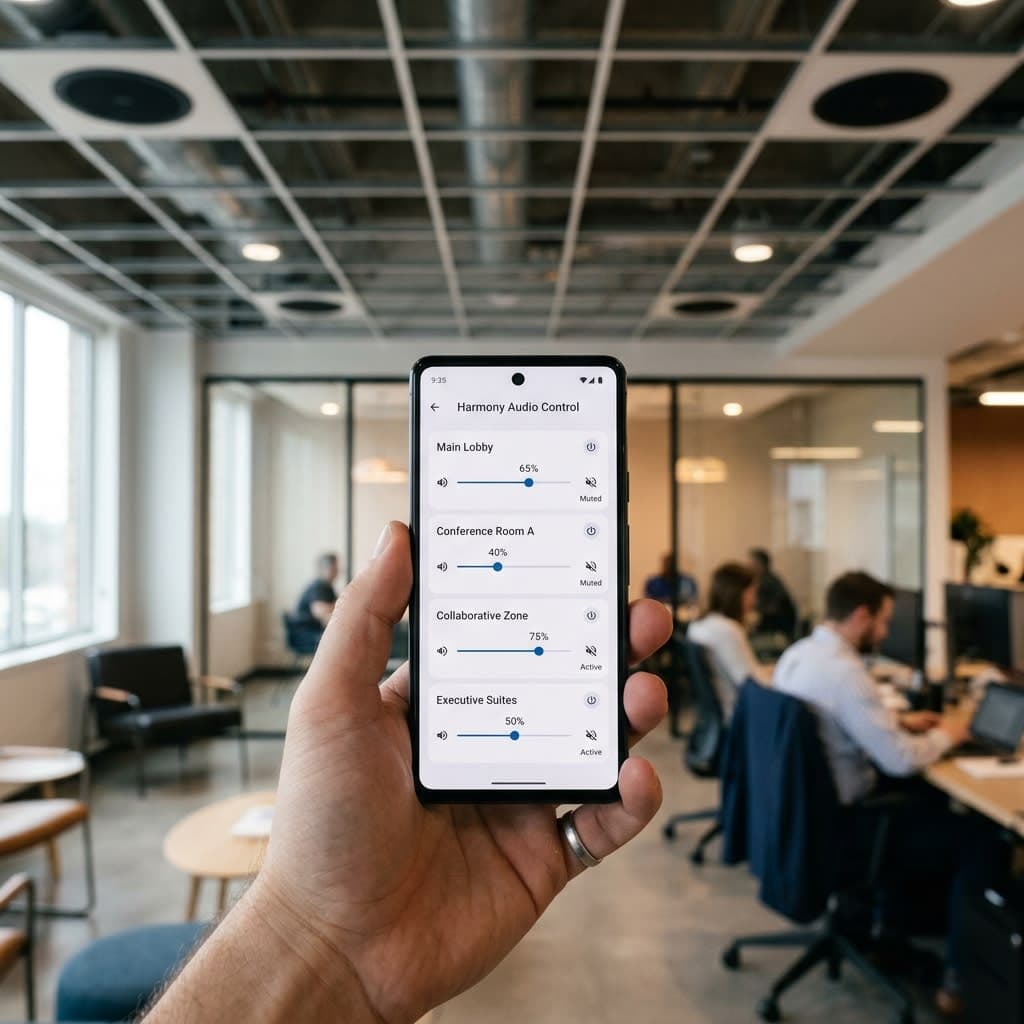
The mobile application on iOS and Android is the end-user interface layer, connecting to the matrix system via internal Wi-Fi or VPN when accessing remotely. Core features include:
- Individual zone volume control: Increase or decrease the volume in the lobby area without affecting the office area.
- Source selection: switch between background music, online radio, and regional emergency announcements.
- EQ adjustment: fine-tuning the tone to suit the acoustic characteristics of each space.
- Schedule automatic playback: set up playlists to play at specific times, for example, soft music in the morning, upbeat music during peak hours.

User Permissions: Manager and Staff
One of the key improvements of the new generation of systems is the ability to assign roles and permissions directly within the app:
- Manager: full access to all zones, edit playback schedule, add/remove audio sources, view system-wide activity logs.
- Staff: are only allowed to adjust volume and switch sources within their assigned area; they cannot change system configurations or access other areas.
This access control mechanism is particularly useful for retail chains — employees at each branch can adjust the volume to suit the store's atmosphere at any given time, while area managers can still remotely control the playlist and overall configuration.

Checklist for implementing system access control:
- Identify the list of regions and the person in charge of each region.
- Set up Manager accounts for regional/area managers.
- Set up Staff accounts with branch-specific access restrictions.
- Regularly check activity logs to monitor system usage.
- Train staff on how to use the app before handing it over for operation.
Integration with Sonos, Q-SYS, and Symetrix
Modern multi-zone audio control ecosystems typically don't operate independently but integrate with dedicated platforms:
- Sonos: suitable for small businesses needing a simple, easy-to-set-up, and cost-effective solution.
- Q-SYS (QSC): A powerful, extensible signal processing and control platform suitable for large systems requiring simultaneous video and lighting control integration.
- Symetrix specializes in high-quality DSP signal processing, suitable for environments requiring demanding audio quality such as auditoriums and recording studios.
Choosing the right platform depends on the current size and expansion plans of the business over the next 3-5 years.
Investment Costs by Scale: 50-500 Million VND
The cost of implementing a multi-zone audio control system varies greatly depending on the number of zones, equipment brand, and level of integration.
Business size
Area code
Estimated cost
Small office, standalone shop
4-8 zones
50-120 million VND
Medium-sized chain stores, office buildings
10-16 regions
150-300 million VND
Large complex, resort, and shopping mall.
20 or more regions
350-500 million VND
The above cost includes the matrix equipment, control software license, zone speakers, and installation labor. Businesses should work directly with the consulting firm to obtain an accurate quote based on their current network infrastructure and the actual number of zones.

Security and Remote Operation
Secure Connection Via VPN
When management needs to control the system remotely (outside the internal LAN), the connection must go through a corporate VPN or encrypted access gateway to avoid the risk of unauthorized access to the audio system — especially important when the system integrates building-wide emergency notification functionality.
Activity Log
Modern systems log all actions: who changed the volume in which zone, at what time, and from which device. This feature is useful for tracing incidents or assessing actual usage levels at each branch to optimize operations.
Security checklist for system deployment:
- Establish a VPN connection or encrypt access for remote access.
- Change the default password of the Matrix device immediately after installation.
- Restricting access based on the principle of least privilege.
- Enable logging and review logs periodically (monthly).
- Regularly update the Matrix device firmware to patch security vulnerabilities.
Trends in the Near Future
Multi-zone audio control technology is continuously evolving towards integrating artificial intelligence to automatically adjust volume based on actual customer density in the space (measured via cameras or sensors), automatically switch playlists based on weather or special events, and integrate more deeply with smart building management systems to synchronize lighting, air conditioning, and security within a single control platform.
Quang Duc's Multi-Zone Audio Deployment Services
Quang Duc Electronics and Telecommunications Co., Ltd. provides multi-zone audio control solutions via mobile app for businesses:
- Survey existing network infrastructure and advise on appropriate matrix configuration to scale.
- We supply and integrate genuine Dante/AVB/AES67 protocol-supported devices.
- Set up the control app and assign user permissions according to the organizational structure.
- Providing operational training for management and staff.
- Maintenance, technical support, and system expansion as the business grows with additional branches.
With the increasingly strong trend of digital transformation, Quang Duc always updates the latest audio technologies to provide suitable and effective solutions for customers.
Conclude
Multi-zone audio control via mobile app is no longer a technology exclusive to large corporations; it has become feasible and cost-effective for small and medium-sized businesses. The transition from discrete amplifier systems to IP-based matrix systems combined with app control offers flexibility, saves operational time, and allows for easy future expansion.
If your business is considering upgrading its sound system to a smart multi-zone control solution, please contact us for advice and a quote tailored to your specific needs.
Hotline: 0903 306 126 (Mr.Vũ Trần) | Website: cameraquangduc.vn