
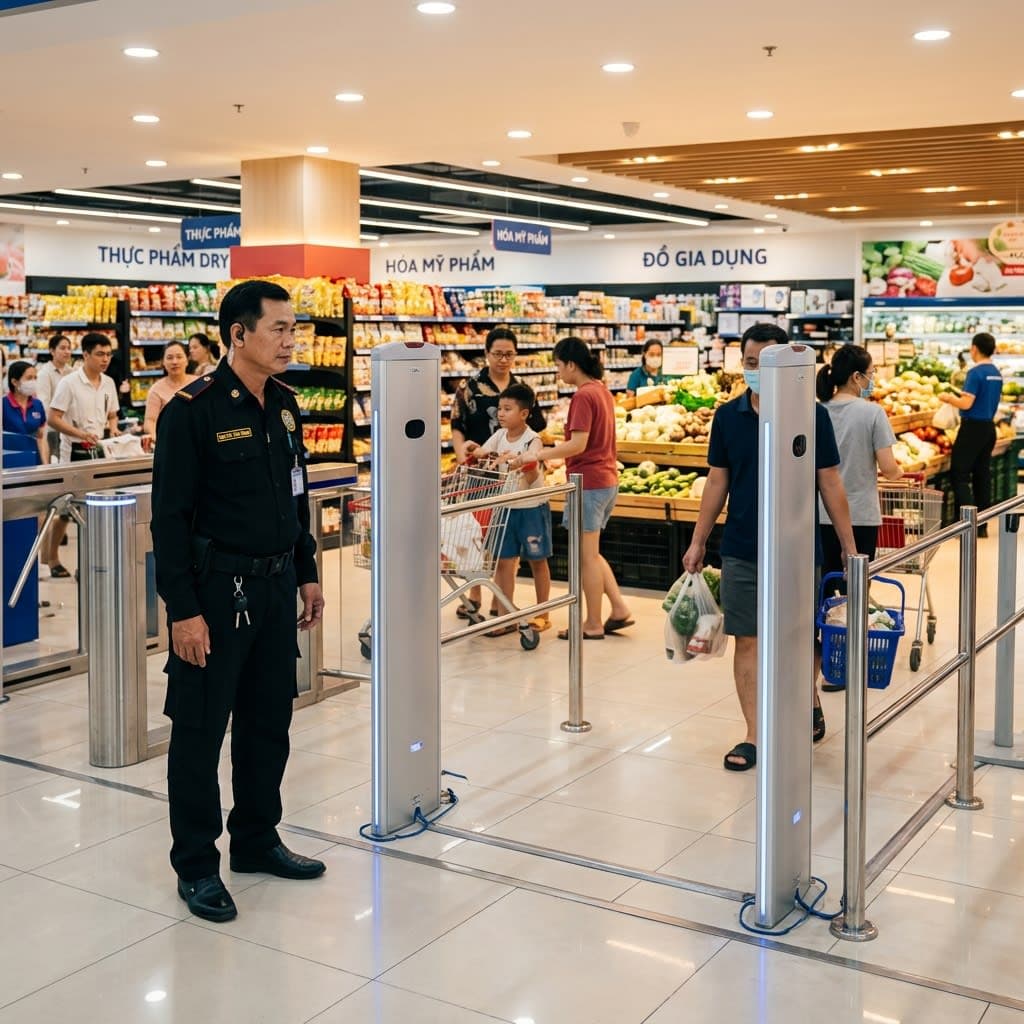
Intercom Systems & Security Gates for Retail Stores
According to data from the Vietnam Retail Association in 2024, merchandise losses due to theft and internal misappropriation account for an average of 1.2–2.5% of the revenue of retail chains, equivalent to tens to hundreds of millions of VND per year depending on the scale. In Da Nang and Quang Nam, the number of mini-supermarkets, convenience stores, and fashion stores grew by more than 25% between 2022 and 2024 , leading to an urgent need for internal communication systems and merchandise protection. This article analyzes in detail two essential solutions: intercom systems and EAS anti-theft gates, helping store owners choose the right products to suit their budget and operational scale.
Two-Way Radio Communication: Analog vs. Digital DMR

Analog Two-Way Radios — An Economical Solution for Small-Scale Businesses
Analog walkie-talkies operate on the VHF (136–174 MHz) or UHF (400–470 MHz) frequency band, using traditional FM modulation. Their main advantages are low cost (1–3 million VND/unit), ease of use, and wide compatibility with many brands. Disadvantages include: significantly reduced sound quality at longer range, lack of signal encryption, and interference from multiple listeners simultaneously.
Suitable for: single-family shops under 500m², restaurants, spas with 2–8 machines operating simultaneously.
Digital DMR Walkie Talkies — The Standard for Modern Retail
DMR (Digital Mobile Radio — ETSI TS 102 361) is the most popular digital radio standard in Vietnam since 2020. TDMA (Time Division Multiple Access) technology allows for two independent communication channels on the same frequency, doubling the capacity compared to analog. Key features:
- HD audio quality: AMBE+2 codec delivers crystal-clear speech even at the edges of the coverage area.
- AES-256 encryption: Secure internal communications, prevent eavesdropping.
- Provides over 40% longer coverage compared to analog systems of the same power (typically 4–5W).
- Tier II mode: Direct machine-to-machine communication within a range of 1–3km; Tier III (trunking) via repeater.
- GPS location tracking is integrated into some models (useful for warehouse personnel management).
Popular brands in the Vietnamese market include: Motorola Solutions, Kenwood, Hytera, and Kirisun. Prices range from 2.5 to 8 million VND per device, depending on features.
Frequency and Licensing
In Vietnam, radio equipment must be licensed according to Decree 47/2011/ND-CP and the Circular of the Ministry of Information and Communications:
- License-free frequency: PMR446 (446 MHz, power ≤0.5W) — short range, for use in small buildings.
- Frequency requiring licensing: VHF/UHF >0.5W — registration procedure at the Radio Frequency Department, annual renewal fee from 500,000–2,000,000 VND/device.
- Enterprise frequency band: 400–470 MHz UHF is typically allocated for retail and logistics.
Repeater — Extends Coverage Area
A repeater receives the signal from a walkie-talkie and retransmits it with higher power, extending the coverage range from a few hundred meters to 2–5 km in urban areas or through multiple floors of a building. A necessary solution for:
- Supermarkets often have multiple floors or basements (weak signal due to reinforced concrete).
- Warehouse with an area of over 2,000m² and many metal shelves (causing interference and signal obstruction).
- The chain of stores connects different locations within the same shopping mall building.
DMR repeater cost: 8–25 million VND/unit depending on power (10W–50W) and features (IP site trunking, IPSC2 multi-point connection via internet).
EAS Anti-Theft Gate System: AM vs RF

Operating Principles of the EAS System
EAS (Electronic Article Surveillance) is an electronic cargo protection system consisting of three components:
- Detection gates (pedestals/antennas): Located at the exit, they transmit and receive signals to detect unactivated labels/tags.
- Security tags/labels: Attached to goods, they provide a signal when passing through a gate.
- Deactivator/Detacher: Disables the label during checkout.
AM (Acoustic-Magnetic) System — High Accuracy
AM magnetic gates operate at a frequency of 58 kHz , using amorphous magnetic material in the tag. When the tag passes through the gate's alternating magnetic field, it resonates at a characteristic frequency, triggering an alarm. Key advantages:
- False alarm rate <0.1% — the lowest among EAS technologies.
- Not affected by aluminum or metal packaging (suitable for supermarkets, food stores, pharmacies)
- Detection range up to 2m (gate width for a single passageway)
- Hard tag AM can be reused thousands of times and is mechanically durable.
Disadvantages: AM labels are more expensive than RF labels (from 2,000–5,000 VND/label ), and the deactivator device is more bulky.
Radio Frequency (RF) Systems — Flexible and Widely Available
RF security gates operate at a frequency of 8.2 MHz , using an LC (inductor-capacitor) circuit within the label to resonate with the gate's RF field. They are more common than AM security gates in fashion and electronics stores.
- Soft RF labels are thinner (<0.5mm) and easier to apply discreetly to packaging.
- Lower label costs: 500–1,500 VND/label (soft label)
- Fast deactivation speed, integrated deactivator directly at the POS counter.
- Some RF labels are "reactivable" — meaning they can be reactivated after purchase (risk if the procedure isn't done properly).
Disadvantages: higher false alarm rate than AM (0.5–2%), affected by metal and aluminum packaging near the port.
Comparison Table of AM vs RF EAS
Criteria
AM (Acoustic-Magnetic)
RF (Radio Frequency)
Operating frequency
58 kHz
8.2 MHz
False alarm rate
<0.1%
0.5–2%
Detection range
Up to 2.0 m
Up to 1.2 m
Popular label types
Reusable hard tag
Soft adhesive labels (disposable)
Label costs
2,000–5,000 VND/label
500–1,500 VND/label
Effective with metals
Good
Less
Typical applications
Supermarket, pharmacy, alcohol
Fashion, electronics, books
Double gate fee
15–35 million VND
8–20 million VND
Practical Application According to Business Model

Mini Supermarkets and Convenience Stores
Walkie-talkie system: 4–8 UHF DMR radios (no repeater needed if area <1,000m²), licensed UHF frequency, channel allocation: cashier — security — warehouse — management.
Security gates: AM system with hard tags for canned food, beverages, and pharmaceuticals. Number of gates: 1 pair/main exit + 1 pair/auxiliary exit. Integrated with IP cameras for recording during alarms.
Fashion and Shoe Store
Walkie-talkies: 3–6 analog PMR446 radios (if area <300m²) or licensed UHF DMRs for a multi-branch chain.
Security gates: RF with soft labels discreetly attached to shoe soles or clothing tags. Hard tags with cable locks for high-end items priced over 500,000 VND. Deactivator integrated at the POS counter.
Warehouses and Distribution Centers
Walkie-talkie: DMR Tier II/III with repeater, 4–5W power output, IP67 dust and water resistant (suitable for cold storage and outdoor warehouses). Integrated GPS for personnel and forklift tracking.
Protecting goods: EAS systems are not common in warehouses; instead, PTZ cameras and access control using magnetic cards/fingerprints are used.
Selection and Installation Checklist
Select Walkie Talkie
- Determine the area and structure of the building (basement, wall materials).
- Count the maximum number of employees that need to be contacted simultaneously.
- The decision of whether to use analog or DMR depends on budget and security requirements.
- Check frequency licensing requirements (if power >0.5W)
- Assess repeater needs through on-site walk-testing.
Select EAS Gate
- Identify the primary product category (food/metals → AM; clothing/electronics → RF)
- Measure the exit width (AM supports up to 2m/dual port; RF up to 1.2m)
- Calculate the annual brand budget (number of products × brand price per unit)
- Determine the location for the gate to avoid placing it near large power sources or iron poles that could cause interference.
- Plan for integration with POS systems and surveillance cameras.
Quang Duc's Walkie Talkie and Security Gate Services
Quang Duc Electronics and Telecommunications Co., Ltd. provides comprehensive communication and anti-theft solutions:
- Consulting, supplying, and installing analog and digital DMR walkie-talkie systems for supermarkets, warehouses, and retail chains in Quang Nam and Da Nang.
- Install EAS (AM and RF) security gates with configurable sensitivity, integrated camera, and alarm system.
- We provide EAS labels (hard tags, soft labels, spider tags) and replacement accessories on a regular basis.
- Assistance with registering and licensing radio frequencies for walkie-talkies in accordance with regulations of the Ministry of Information and Communications.
- Maintenance, repair, and upgrade of existing radio communication and security gate systems.
Quang Duc has deployed walkie-talkie and security gate systems for numerous supermarkets, chain stores, and industrial zones in Quang Nam and Da Nang, providing practical solutions and long-term operating cost savings.
Conclude
Investing in walkie-talkie and EAS (Earth Leakage System) systems not only reduces merchandise losses but also improves staff coordination efficiency, creating a safe and professional shopping environment. With an initial investment of 15-80 million VND depending on store size, the payback period is typically under 12 months once merchandise loss rates are significantly reduced.
The choice between AM or RF technology, analog or DMR, should be based on the specifics of the industry, floor space, and implementation budget. Quang Duc is ready to conduct free on-site surveys and propose the most optimal solution for each specific business model.
Contact us now for expert advice and a quote on installing walkie-talkies and security gates for your store in the Quang Nam-Da Nang area.
Hotline: 0903 306 126 (Mr.Vũ Trần) | Website: cameraquangduc.vn


