
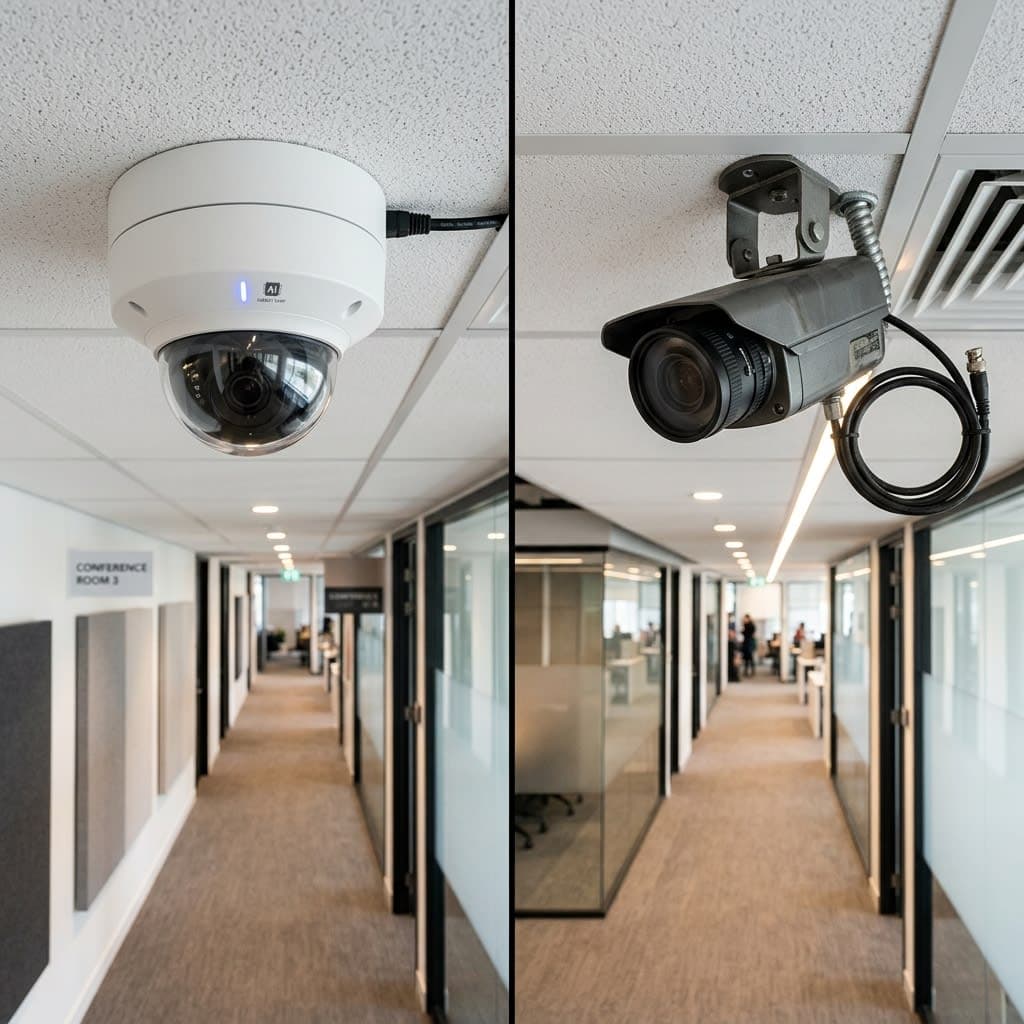
Comparing AI Cameras vs. Analog Cameras: Which Type Should Businesses Invest In?
The Vietnamese enterprise surveillance camera market is shifting strongly towards AI technology, with over 45% of newly installed camera systems in 2025 integrating intelligent analytics features, according to a security industry survey. However, the price difference between AI cameras and traditional analog cameras can be as much as 2-3 million VND per camera, causing many businesses to hesitate between technological efficiency and their actual budget.
This article delves into a comparison of AI and analog cameras based on core technical criteria—processor chip, bandwidth, storage cost, detection accuracy—to help businesses make informed decisions about surveillance camera investments that align with their scale and operational goals.
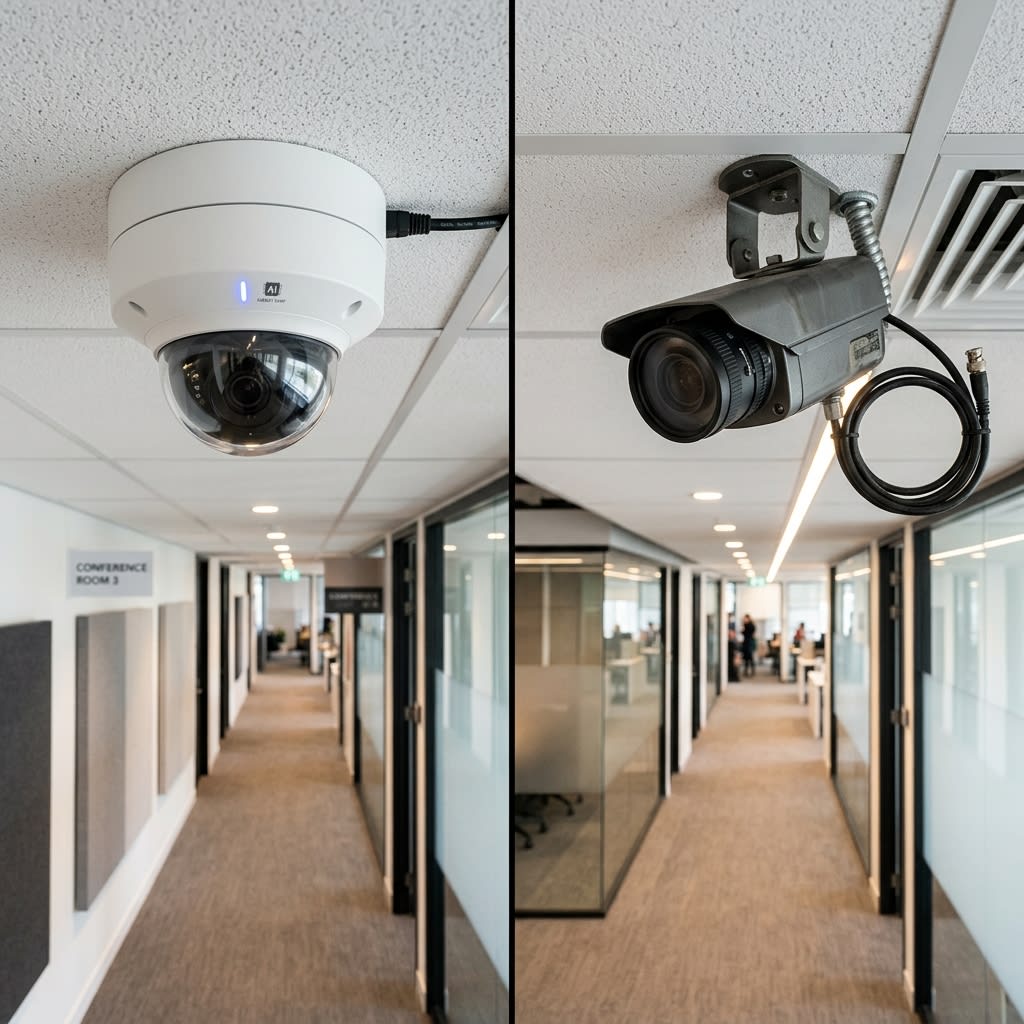
Processing Architecture: NPU Chip vs. Central Processing Unit
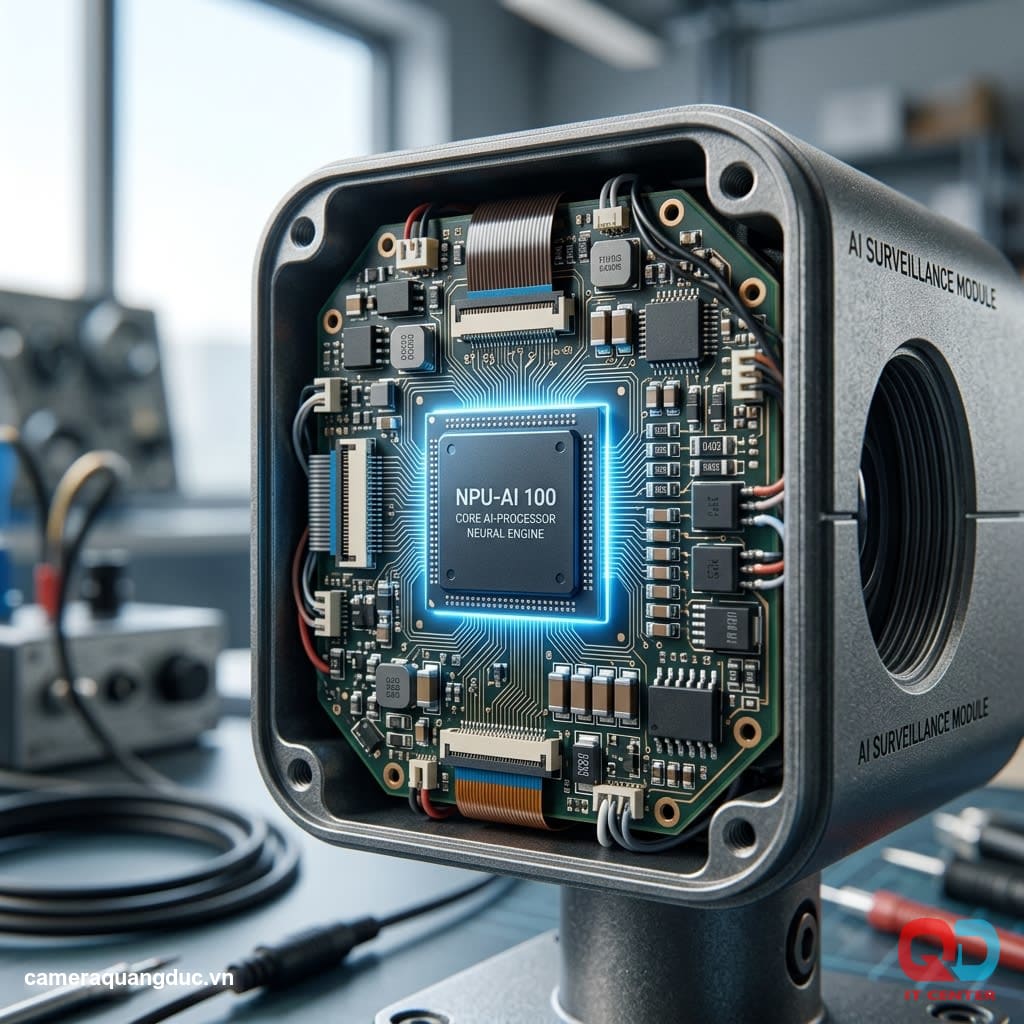
AI Camera — Edge Computing
AI cameras integrate a dedicated NPU (Neural Processing Unit) chip directly into the camera body, allowing for image analysis—identifying people, vehicles, faces, and unusual behavior—directly at the recording location without sending the entire video stream to a central processing unit.
- Processing speed: Modern NPU chips process 2–4 TOPS (Tera Operations Per Second), sufficient to run simultaneous object recognition and behavior analysis in real time.
- Alert delay: Less than 1 second from event detection to alerting the management app.
- Noise filtering capability: Distinguishes between people/vehicles and rustling leaves, shadows, and insects flying through the lens — reducing false alarms by 80–90% compared to conventional motion sensors.
Analog Cameras — Centralized Processing at the DVR
Analog cameras only handle capturing images and transmitting raw signals to the digital video recorder (DVR). Any processing—if any—takes place within the DVR, which has limited computing power.
- There is no capability for intelligent analysis on each individual camera.
- Basic motion sensors are prone to false alarms due to changes in lighting, wind, and insects.
- It depends entirely on the configuration and processing load of the central recorder.
Bandwidth and Network Infrastructure
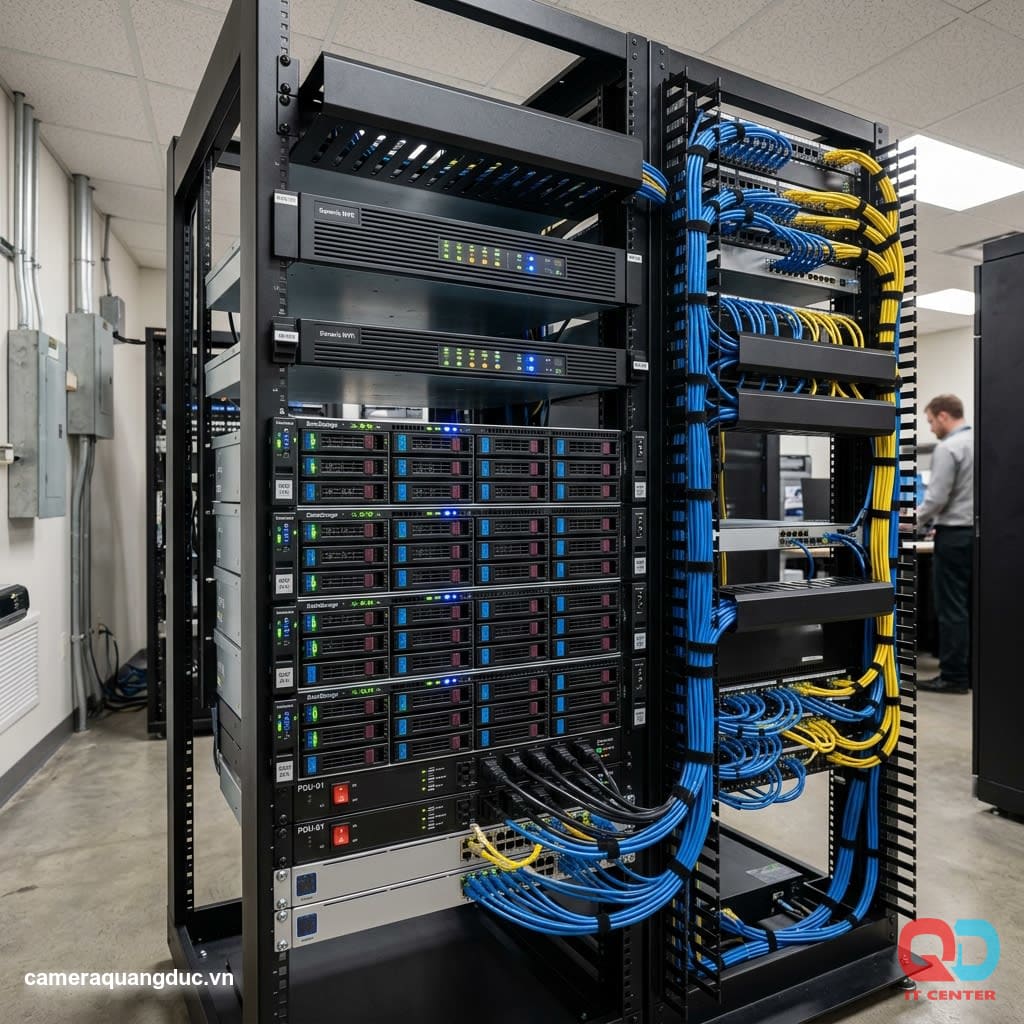
This is the most significant technical difference that directly impacts a business's network infrastructure costs.
Criteria
AI Camera
Standard Analog/IP Cameras
Average bandwidth/camera (1080p)
1–2 Mbps (intelligent compression when no events occur)
3–5 Mbps (continuous transmission)
Requires a PoE switch.
PoE+ switch 8-16 ports, gigabit
Regular switches, no gigabit required.
Signal transmission cable
CAT6 (IP) network cable
RG59 Coaxial Cable (Pure Analog)
Scalability
Easily add cameras via PoE switch.
Recorder channel limit (4/8/16/32)
Download central server
Low — distributed processing at the camera
High — DVR handles everything
With systems of 20 or more cameras, this bandwidth difference determines whether the business needs to upgrade its network infrastructure (switch, cable, NVR) — the cost of upgrading infrastructure sometimes exceeds the cost of the cameras themselves.
Data Storage Costs
Intelligent Storage Mechanism of AI Cameras
The AI camera supports Smart Codec (AI-based intelligent compression), recording only high-quality footage when a significant event occurs (people, vehicles, noticeable movement) and reducing bitrate in static frames.
- Saves 40–60% of hard drive space compared to continuous recording at fixed resolution.
- A 4TB hard drive can store 30 days of data for 16 AI cameras, compared to only 15–18 days with analog cameras of the same resolution.
- It supports intelligent object-based searching (searching for "the person wearing a red shirt who passed by at 2 PM") instead of manually fast-forwarding through each video segment.
Traditional Storage of Analog Cameras
Analog cameras record continuously according to a fixed schedule (24/7 or according to time slots) and do not have the ability to intelligently compress content.
- Storage capacity is linearly proportional to the number of cameras and resolution.
- Smart search is not supported — you have to scroll manually or rely on timestamps.
- The cost of hard drives/NVRs for the same storage duration is 30–50% higher.
Detection Accuracy and Intelligent Features
Checklist of Common AI Features
- Face Recognition — 95–99% accuracy in good lighting conditions.
- Real-time Intrusion Detection
- Automatic people counting, generating hourly/daily reports.
- License Plate Recognition (LPR)
- Unusual crowd detection, forgotten objects (Object Left/Removed)
- Real-time mobile app alerts with event photos.
Analog Cameras — Feature Limitations
Basic analog cameras only record and play back footage. Some high-end analog models (HD-CVI/TVI/AHD) have simple motion sensors but lack object classification capabilities, leading to significantly higher false alarm rates — an average of 15–20 false alarms per day compared to 2–3 false alarms per day in AI cameras.
Total Cost Analysis (TCO) Over 5 Years
Category
AI Camera (16 channels)
Analog Camera (16 channels)
Initial equipment costs
45–65 million VND
20–30 million VND
Network infrastructure (PoE switch, cable)
8–12 million VND
3–5 million VND
Storage costs (hard drive for 5 years, including replacement)
6–8 million VND
10–14 million VND
Personnel costs for supervision (estimated reduction thanks to AI)
Reduce manual monitoring time by 30–40%.
Continuous monitoring by a supervisor is required.
Estimated total cost of ownership over 5 years
65–90 million VND
55–75 million VND, but the risk of missing an event is higher.
AI cameras have a higher initial cost, but this is offset by reduced storage costs, a decrease in manual monitoring personnel, and reduced losses due to delayed incident detection (theft, workplace accidents, internal fraud).
Which Type Should You Choose? Based on Scale and Needs
- For fewer than 8 cameras, with a limited budget and basic surveillance needs: Analog/IP cameras are often still a reasonable choice for small shops and warehouses with low risk.
- 8–30 cameras, proactive alerts needed: AI cameras deliver a clear ROI — reduced camera monitoring personnel, instant incident detection.
- For factories/industrial parks with over 30 cameras, AI cameras are almost mandatory for managing massive amounts of data, integrating facial recognition for timekeeping, and controlling workplace safety.
- Retail and supermarket industry: AI cameras assist in customer counting and shopping behavior analysis — value far exceeding pure security functions.
Frequently Asked Questions When Converting from Analog to AI
Is it possible to reuse the existing coaxial cable infrastructure?
With existing HD-CVI/TVI/AHD camera systems using RG59 coaxial cable, businesses cannot directly upgrade to pure IP AI cameras because AI cameras require CAT5e/CAT6 network connectivity and PoE power. However, some hybrid AI camera models support signal transmission over existing coaxial cable (HD-AI over coax technology), saving on the cost of new wiring – suitable when the existing cabling infrastructure is still good but the installation budget is limited.
Do AI cameras need a constant internet connection?
Not mandatory. Most AI analysis features (person and vehicle recognition, intrusion detection) are processed directly at the camera (Edge AI) and stored locally in the NVR/hard drive, independent of an internet connection. An internet connection is only necessary if the business wants to view the camera remotely via a mobile app or receive instant push notifications.
Are AI cameras prone to false recognition errors?
The false recognition rate of next-generation AI cameras has decreased significantly thanks to deep learning algorithms trained on large datasets, but the following points should still be noted:
- Install at the recommended angle and height (2.5–4m depending on the area) for optimal accuracy.
- Ensure sufficient nighttime lighting using infrared lights or specialized supplementary lighting.
- Regular firmware updates are necessary because the manufacturer continuously improves the algorithms through each update.
A Gradual Transition Roadmap from Analog to AI for Businesses with Limited Budgets
Not every business can replace its entire analog system with AI immediately. A sensible, step-by-step transition plan is necessary:
- Phase 1 (0–6 months): Prioritize installing AI cameras in key locations — entrances, warehouses, cashier/payment areas.
- Phase 2 (6–18 months): Gradually upgrade the PoE network infrastructure by region, replacing old, fully depreciated analog cameras.
- Phase 3 (18–36 months): Complete the entire AI system, integrate centralized management software and advanced analytical features (customer counting, facial recognition).
This approach helps businesses allocate budgets effectively each fiscal year while ensuring that high-risk areas are protected with AI technology as early as possible.
Quang Duc's AI Surveillance Camera Service
Quang Duc Electronics and Telecommunications Co., Ltd. provides consulting and implementation services for AI-powered surveillance camera solutions tailored to businesses of all sizes.
- Survey the current situation and advise on choosing between AI and analog cameras based on budget and practical goals.
- Designing a PoE network infrastructure that optimizes bandwidth for large-scale AI camera systems.
- AI feature configuration: facial recognition, people counting, intrusion detection, license plate recognition.
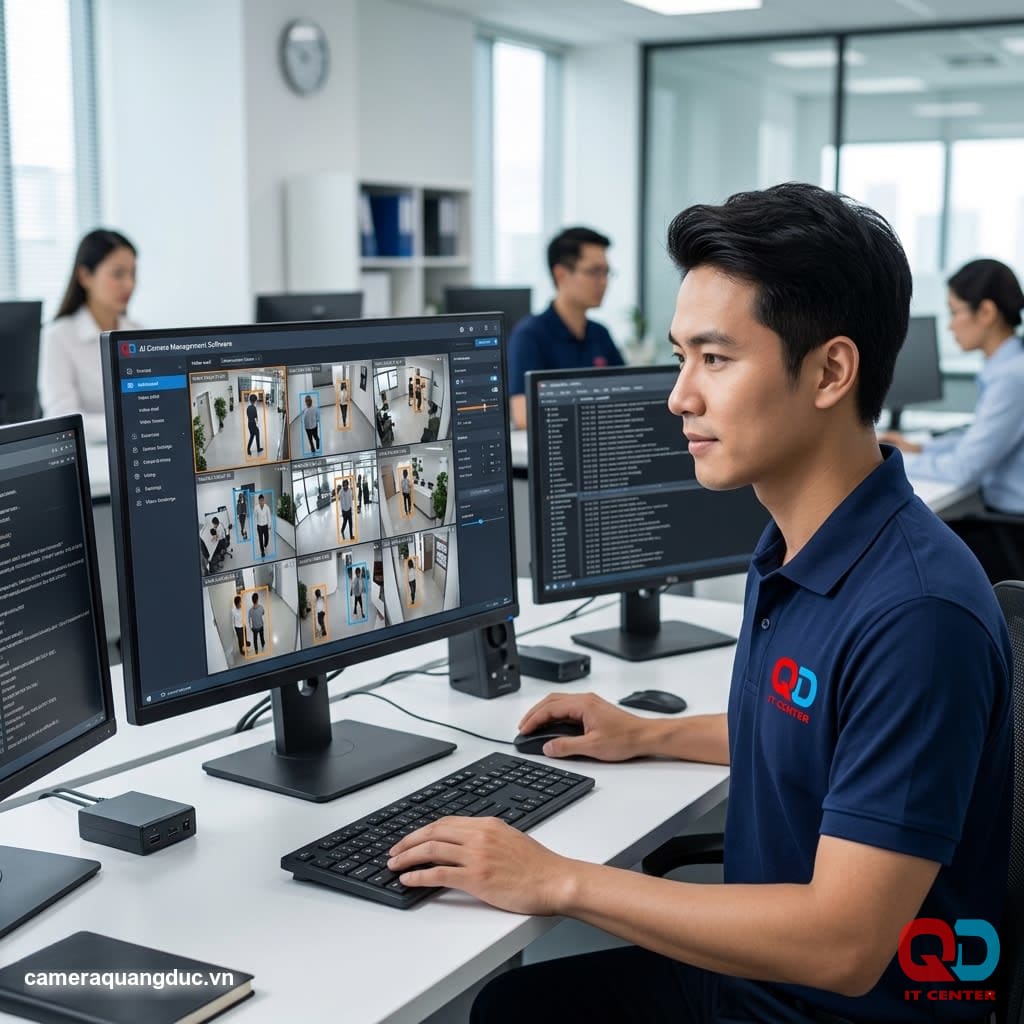
- Integrated centralized management software, real-time alerts via mobile app.
- Warranty, regular maintenance, and prompt local technical support.
Quang Duc's technical team has deployed hundreds of camera systems for factories, offices, shops, and residential areas, ensuring that the proposed solutions are tailored to the actual operations and budget of each business.
Equipment Maintenance and Lifecycle
Element
AI Camera
Camera coordinate
Average life expectancy
5–7 years (depending on the processor chip)
6–8 years (simple design, few components)
Firmware update frequency
2–4 times/year to improve AI
Rarely updated
Replacement cost when damaged
Higher price due to specialized components.
Lower price, easily replaceable equivalents.
Risk of technological obsolescence
Higher due to rapid AI development.
Low cost, long-term stable technology.
Conclude
There's no single "right" answer between AI and analog cameras — the investment decision depends on the scale, budget, and level of risk the business needs to manage. AI cameras are suitable for businesses requiring proactive monitoring, reduced reliance on human resources, and a long-term system expansion vision. Analog cameras remain the economical solution for basic surveillance needs.
To get an accurate assessment of your company's system, let the Quang Duc technical team conduct a direct survey and provide the most optimal solution.
Hotline: 0903 306 126 (Mr.Vũ Trần) | Website: cameraquangduc.vn


