
IP Call Center for Small and Medium-Sized Businesses: A Cost-Effective Solution
The operating costs of a traditional customer service call center—including landline lines, analog switchboards, and manual call center staff—can account for 8–12% of a small and medium-sized enterprise's monthly marketing/sales budget. Meanwhile, a modern IP Call Center solution can reduce call costs by 60–70% thanks to VOIP technology, while also adding service quality management features that traditional call centers lack.
This article focuses on practical call center applications for small and medium-sized businesses—the number of concurrent lines required, IVR (intercom system) configuration, call recording, performance reporting—to help businesses scale correctly and avoid over-investment or under-investment.

What is an IP Call Center and how does it differ from a traditional call center?

An IP Call Center is a call center system that operates on the VOIP (Voice over Internet Protocol) protocol, allowing calls to be made and received over the internet instead of traditional analog telephone lines. The core difference compared to a conventional IP-PBX lies in its specialized features for customer service centers :
- Call Queue: Automatically queues and distributes calls to available staff.
- Automatic Call Distribution (ACD): Routing based on skill level and customer priority.
- Real-time Monitoring: Managers can view the number of pending calls and the average waiting time.
- Detailed reports by employee/team/service time slot for KPI evaluation.
Determine the Appropriate Number of Simultaneous Lines Based on Business Size
One common mistake when investing in a call center is choosing the wrong number of concurrent call lines—leading to wasted licenses or call congestion during peak hours.
Customer service team size
Number of simultaneous lines recommended
Minimum internet bandwidth
3–5 employees
5–8 lines
10 Mbps upload/download
6–10 employees
10–15 lines
20 Mbps upload/download
11–20 employees
15–25 lines
35 Mbps upload/download
Over 20 employees
25–40 lines (cloud call center should be considered)
50 Mbps or higher, with a backup connection.
Quick estimate formula: Number of simultaneous lines ≈ (Number of employees × 1.3) to account for call waiting and internal forwarding. Each G.711 quality VOIP voice call consumes approximately 87–100 Kbps of bidirectional bandwidth.
Effective IVR (Interactive Voice Response) Configuration
IVR is an automated answering system that helps customers self-direct to the correct department without needing an initial call center agent to handle their request.
Principles of IVR Script Design for Small Businesses
- A maximum of 3–4 options in the main menu — too many options are overwhelming and increase the likelihood of customers dropping out of the call.
- Offer the option to speak directly with a staff member (press 0) at all menu levels for elderly or urgent customers.
- Record a professional greeting message , clearly stating business hours and other support channels if outside of those hours.
- Integrate location notifications into the queue: "You are currently ranked 3rd, your estimated wait time is 2 minutes."
Example of a Basic IVR Structure
- Company greeting + main menu
- Press 1: Sales Department / Product Consulting
- Press 2: Technical/Warranty Department
- Press 3: Accounting/Accounts Payable Department
- Press 0: Speak directly to the receptionist/operator.
Call Recording and its Application in Quality Management
Call recording serves not only legal purposes but also acts as a training tool and helps improve customer service quality.
Checklist for implementing compliant and effective call recording:
- Store audio recordings for a minimum of 3–6 months as needed for dispute resolution purposes.
- Inform customers about call recording at the beginning of the call (in compliance with personal data protection regulations).
- Categorize audio recordings by employee, department, and customer satisfaction level.
- Listen to random samples weekly to assess the quality of advice.
- Perform regular backups to avoid data loss in case of system failure.
- Audio recording access control — only administrators and authorized personnel can listen
Call Center Performance Reporting and Measurement
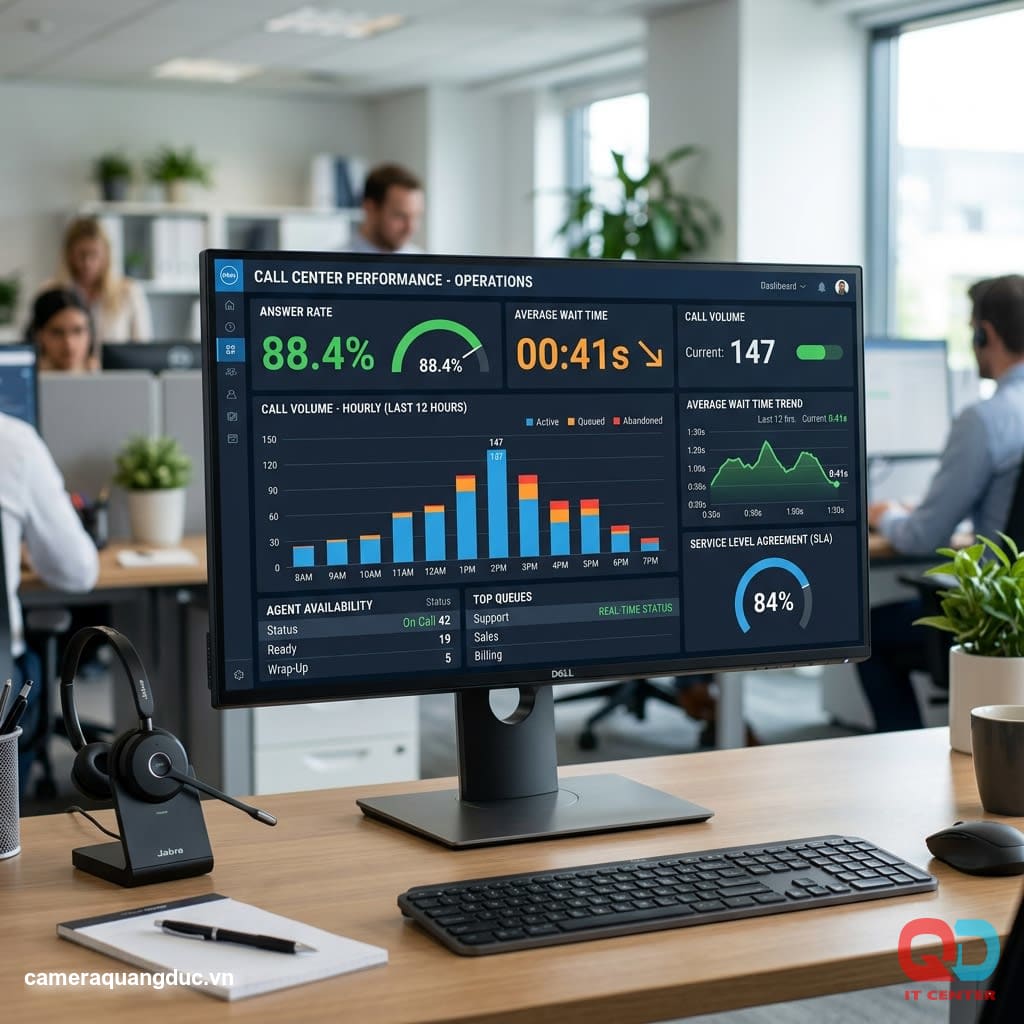
Modern call center systems provide real-time and recurring reporting dashboards to help managers make data-driven decisions:
- Answer Rate: Target above 90% during business hours.
- Average Wait Time: Should be under 30 seconds to maintain a good customer experience.
- Average Handle Time: Measures the performance of each employee and identifies areas requiring further training.
- Missed Call Rate: Alerts are triggered when the rate exceeds 5–10%, prompting the need to add staff during peak hours.
- Hourly reporting: Identify peak hours to allocate shifts effectively.
Cost of Deploying an IP Call Center for Small Businesses
Category
Estimated cost
Call Center software (10-line license)
15–25 million VND (outright purchase) or 2–4 million VND/month (subscription)
IP Phone devices (10 units)
8–15 million VND
Specialized noise-canceling headsets (10 sets)
3–5 million VND
Monthly VOIP call charges
60–70% reduction compared to traditional analog rates.
Costs for IVR deployment, configuration, and training.
5–10 million VND
Estimated total initial investment
25–55 million VND for a team of 5–10 employees
Comparing On-Premise and Cloud Call Center Deployments
Criteria
On-Premise IP PBX
Cloud Call Center
Initial investment cost
Higher cost (buying equipment, servers)
Lower (monthly subscription)
Long-term operating costs
Lower after 2-3 years of depreciation.
Stable but accumulating over time.
Data control
Complete on-site control
Dependent on the service provider.
Scalability
More hardware investment is needed.
Expand flexibly according to needs.
Implementation time
1-2 weeks (installation, configuration)
A few days (mostly software configuration)
Suitable for
Businesses with existing IT infrastructure want to control their data.
New, fast-growing businesses need flexibility.
Small and medium-sized enterprises (SMEs) with limited budgets and small IT teams often prioritize Cloud Call Center solutions to avoid initial infrastructure investment costs, while businesses with existing IT departments and a priority on internal customer data security will opt for On-Premise solutions.
Common Mistakes When Implementing a Call Center for Small Businesses
- Investing in too many lines simultaneously compared to actual needs: This leads to wasted licenses; it's better to start small and expand gradually.
- Ignoring internet bandwidth surveys: Unstable connections cause lag and dropped calls, negatively impacting the customer experience.
- The IVR design is too complicated: Customers abandon calls because they have to listen to overly long menus before they can speak to a staff member.
- Lack of training for staff to fully utilize features: Wasting resources on tools like smart call forwarding and customer notes.
- Neglecting regular report analysis: Failure to promptly identify service quality issues or peak-hour staffing shortages.
Quang Duc's IP Call Center Service
Quang Duc Electronics and Telecommunications Co., Ltd. provides comprehensive IP Call Center solutions for small and medium-sized enterprises:
- Assess team size, advise on the number of simultaneous lines, and recommend a suitable license package.
- Designing professional IVR scripts tailored to specific industry needs.
- Configure call recording settings and access permissions in compliance with security regulations.
- Set up a real-time performance reporting dashboard for management and monitoring.
- Training call center operators to use the system proficiently and provide quick technical support.

Integrate your Call Center with CRM and Other Customer Service Channels.
The current trend is to integrate IP call centers with customer relationship management (CRM) software to improve customer service efficiency.
- Automatic customer information display (Screen Pop): When a call comes in, the screen automatically displays the transaction history and orders of that customer.
- Omnichannel Synchronization: Combine voice calls with Zalo chat, Facebook Messenger, and email within a single management interface.
- Automatic interaction history recording: Every call is saved to the customer's profile in the CRM, eliminating the need for other staff members to ask for information again.
- Customer journey analysis: Combining call data with other touchpoints to evaluate the overall experience.
This integration allows small and medium-sized businesses to operate as a professional customer service center without needing to invest in separate data management personnel.
Checklist for assessing CRM integration readiness:
- Does the current CRM software support APIs for connecting to an IP PBX?
- Is the internal IT team capable of performing the integration configuration, or is outsourcing necessary?
- Clearly identify which data needs to be synchronized (call history, recordings, customer information).
- There are plans to train staff on how to use the new integrated interface.
Actual Implementation Time
Scale
Installation and configuration time
Employee training time
Under 5 employees
2–3 days
1 day
5–15 employees
4–6 days
1–2 days
For over 15 employees, CRM integration is recommended.
7–10 days
2–3 days
Conclude
An IP Call Center is a cost-effective solution for small and medium-sized businesses looking to improve customer service without investing in expensive infrastructure like larger enterprises. Choosing the right number of lines, configuring the appropriate IVR, and leveraging performance reporting will help businesses operate a professional customer service center within a reasonable budget.
Contact Quang Duc for a free survey and consultation on a Call Center solution tailored to the size of your company's team.
Hotline: 0903 306 126 (Mr.Vũ Trần) | Website: cameraquangduc.vn


