
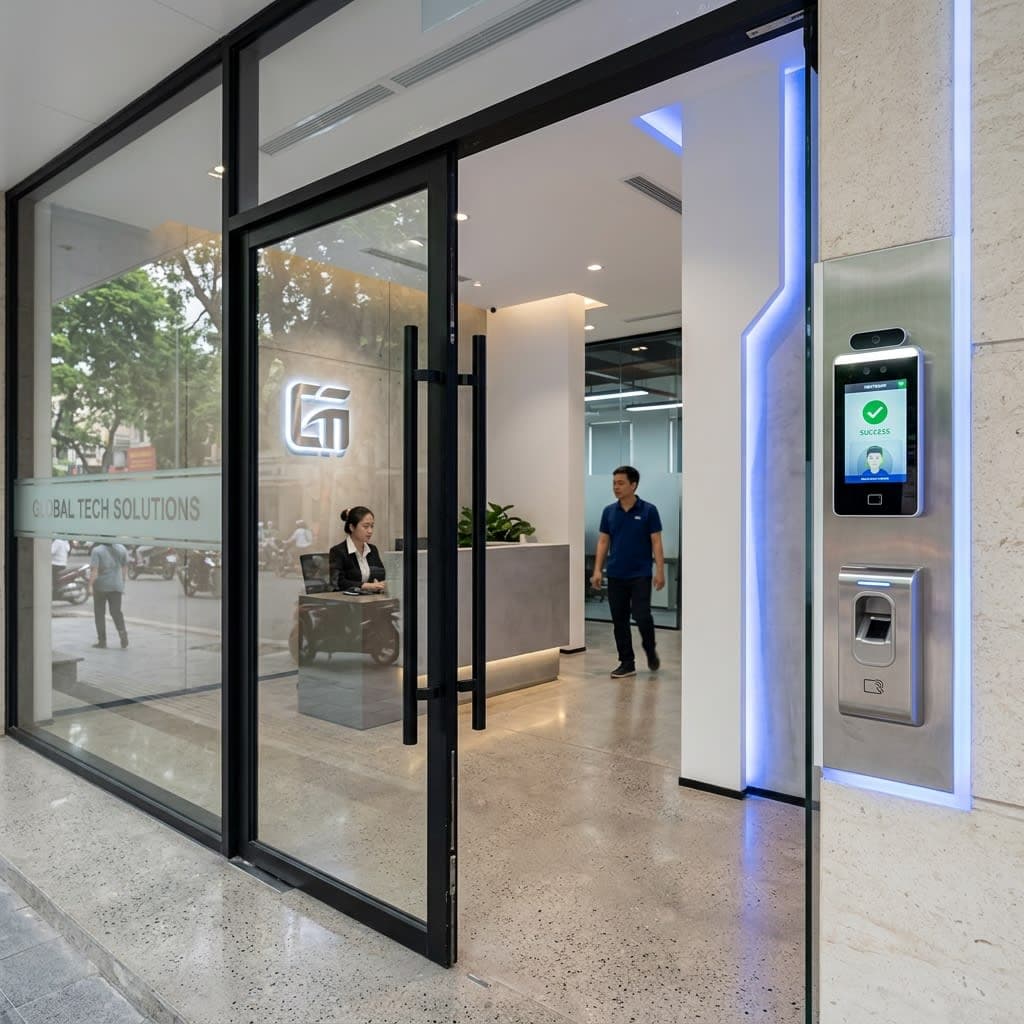
Access Control via Fingerprint, Card, and Facial Recognition: Absolute Internal Security
A 2024 report by the Vietnam Security Association indicates that 43% of data breaches and 61% of internal asset losses in Vietnamese businesses stem from physical access control vulnerabilities—unauthorized individuals gaining access to sensitive areas by using borrowed access cards, duplicate keys, or simply following authorized personnel. The average cost of a failed access control incident can reach VND 150–300 million . Modern access control systems effectively address this issue.
Overview of Access Control System Architecture

Professional access control systems are built on a hierarchical model: readers authenticate identities, controllers process decisions, locks/barriers execute commands , and management software monitors the entire system.
Architectural Controller
The controller is the brain of the system — storing the user database, permission rules, and event history. Two common architectures:
- Standalone Controller: Each door has an independent controller, suitable for systems with 1–8 doors, low cost, no server required.
- Network Controller: A controller that manages multiple doors over a LAN/IP network, centralizing management, suitable for systems with 8–500+ doors.
The new trend: Cloud-based Access Control enables remote management via browser, automatic software updates, and eliminates the need for on-premises servers — ideal for businesses with multiple branches.
Comparing 4 Authentication Methods
Method
Cost per point
Security level
Speed
Toilet
Most suitable
MIFARE/RFID card
Low (5–15,000 VND/card)
Medium
< 0.5 seconds
High
Office, building
PIN/Password
Very low
Short
3–5 seconds
High
Support area
Fingerprints
Medium
High
0.5–1 second
Short
Factory, warehouse
face
High
Very high
0.2–0.5 seconds
Very high
Office, healthcare
RFID/MIFARE Magnetic Cards — Fast and Economical
MIFARE Classic 1K and MIFARE DESFire EV3 cards are the most common standards in Vietnam. MIFARE DESFire cards with AES-128 encryption are significantly more secure than MIFARE Classic (which has been cracked since 2008). Card readers support both types for backward compatibility.
Important note: RFID tags can be cloned using inexpensive devices available on the market. For increased security, pair the tag with a two-factor PIN for sensitive areas.
Fingerprints — Cannot be Lost, Cannot be Lended
Optical fingerprint sensors are inexpensive but can be fooled by printed images. Capacitive semiconductor sensors distinguish between real and fake fingers and are more moisture-resistant—making them the right choice for industrial environments. Typical storage capacity: 3,000–10,000 fingerprints per device.
Facial Recognition — Contactless Authentication
Next-generation facial recognition uses 3D infrared cameras (structured light or time-of-flight) to create a three-dimensional facial map — unfazed by flat photos or videos. Key features:
- Face mask recognition — crucial after the pandemic.
- Operates in low light conditions down to 0 lux (infrared illumination).
- Liveness detection combats forgery using photos, videos, and masks.
- Verification speed: 0.2–0.3 seconds/person
Limitations: High temperatures and direct sunlight can affect accuracy — covering or selecting equipment with specialized filters for outdoor installation is necessary.
Mobile Credential — Mobile Phones Replace Cards
A new trend in Vietnam: using smartphones as access cards via NFC or Bluetooth Low Energy (BLE) . Advantages: no need to print cards, instant access granting/revocation via app. Suitable for technology companies, co-working spaces, and service offices.
Advanced Features for Businesses
Anti-Passback — Prevents Access Sharing
Anti-passback is a mandatory feature for any serious business system. The rule is: after a card/fingerprint is used to enter, it must be used again to exit before it can be used again — absolutely preventing the lending of cards or scanned fingerprints to multiple people at the same time.
Two modes:
- Hard Anti-Passback: Completely deny entry/exit if entry/exit rules are violated.
- Soft Anti-Passback: Allows but logs violations for review.
Multi-Level Authorization and Time Scheduling
A good access control system should support:
- Time Zone: Employee A is only allowed to access the premises from 7:00 AM to 6:00 PM on weekdays.
- Holiday Schedule: Automatically closes on holidays, no manual intervention required.
- First Person In Rule: The important room only opens when at least two people are present (Two-Man Rule)
- Supervisor Override: Managers can remotely unlock the door in case of emergency via the app.
Integrating Timekeeping and Human Resources Software
This is a direct economic benefit that is often overlooked: the access control system also doubles as a highly accurate timekeeping system . Actual in/out data is exported directly to HRM/payroll software (AMIS, KiotViet, Fast Accounting) via API or Excel/CSV file.
Specific benefits:
- Completely eliminate timekeeping fraud (no more clocking in for someone else).
- Automated reports: working hours, late arrivals, early departures, overtime.
- Automated payroll calculation reduces errors and saves HR personnel.
Manage Doors in Multiple Buildings from a Single Software
Businesses with multiple locations or branches can manage everything on a single web/cloud platform. Add new employees, grant access to branches A and B, revoke access instantly upon employee departure — all in seconds from the central office.
Application by Facility Type
Corporate Office (20–200 Employees)
Typical office configuration: card reader + fingerprint scanner at the main entrance, magnetic card access for side doors and meeting rooms, facial recognition in the server room/finance room. Combined with a visitor management system to control access to the company.
Production Factory
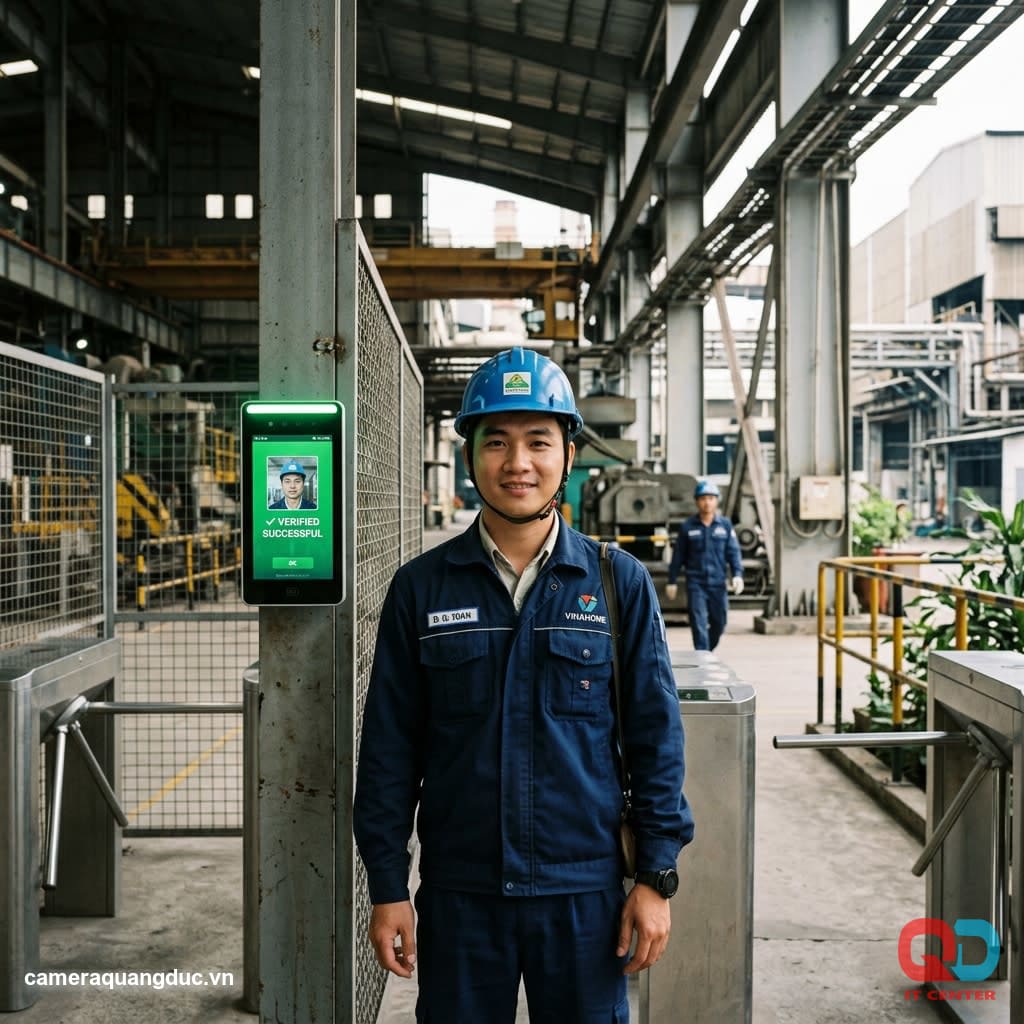
Factory environments require equipment that is resistant to dust, grease, and high humidity. Choose a reader with an IP65 rating or higher. Optical fingerprint sensors can malfunction when hands are oily—consider switching to facial recognition or environmentally resistant RFID tags.
Controlling separate workshops (raw materials area, finished goods area, hazardous machinery area) helps to accurately trace responsibility when an incident occurs.
Data Center
Datacenters require absolute security: mandatory multi-factor authentication (card + PIN + fingerprint), mantrap (double-locking doors — only one person can enter at a time), AI cameras recording all activity, and access logs stored for a minimum of one year as per compliance requirements.
Quang Duc's Access Control Service

Quang Duc Electronics and Telecommunications Co., Ltd. provides comprehensive access control solutions:
- Consulting and designing systems suitable for the size and industry of your business.
- Install fingerprint readers, MIFARE/RFID card readers, and international standard facial recognition systems.
- Integrates automatic timekeeping, connects to HRM software and payroll systems.
- Multi-level access control configuration, anti-passback, and shift-based time scheduling.
- Equipment warranty, system administration training, and 24/7 technical support.
Over 150 businesses in Quang Nam and Da Nang have trusted Quang Duc to implement access control systems — from offices with 10 people to production workshops with hundreds of workers.
Conclude
Internal security isn't just about preventing outsiders from entering—it's also about ensuring the right people are in the right place at the right time. Fingerprint, card, and facial recognition access control systems create an uncompromising physical barrier while automating employee timekeeping—a double-edged investment.
Whether your business has 20 or 2,000 employees, Quang Duc has the right solution. Contact us today for a free survey and consultation on designing the optimal access control system for each area of your facility.
Hotline: 0903 306 126 (Mr.Vũ Trần) | Website: cameraquangduc.vn


