Automatic Fire Alarm System for Apartments and Hotels: Compliant with Vietnamese Fire Safety Standards
According to data from the Fire Prevention and Rescue Police Department, the majority of serious casualties in apartment and hotel fires occur due to late detection of the fire — the golden time for safe evacuation is only about 3-5 minutes from the time the fire begins to spread. A properly functioning automatic fire alarm system can detect smoke or unusual heat within 30 seconds, creating a critical time window for evacuation and extinguishing the fire in its early stages.
This article provides a comprehensive overview of automatic fire alarm systems according to TCVN 5738:2021 standards , helping apartment building managers and hotel investors understand the legal and technical requirements for implementation.
TCVN 5738:2021: Mandatory Standard for Construction in Vietnam
TCVN 5738:2021 — Automatic fire alarm systems, Technical requirements — is a national standard specifying the design, installation, and acceptance testing of fire alarm systems for various types of buildings, including apartment buildings, hotels, and shopping centers.
The core requirements of TCVN 5738:2021
- Fire alarm zoning: Each floor and functional area must be zoned separately to quickly identify the location of a fire.
- Smoke detector installation distance: Specific regulations stipulate the maximum distance between smoke detectors (usually no more than 9m), depending on the area and ceiling height.
- Response time: The system must trigger an alarm within 10 seconds of the detector detecting the fault.
- Backup power supply: A backup power supply (battery) is required to maintain operation for a minimum of 24 hours in monitoring mode and an additional 30 minutes in system-wide alarm mode.
Additional legal requirements
In addition to TCVN 5738:2021, apartment buildings and hotels must also comply with:
- QCVN 06:2022/BXD — National Technical Regulation on Fire Safety for Buildings and Structures
- Fire protection design review before construction and acceptance testing before commissioning.
- Regular inspections as required by the local Fire Prevention and Control Police agency.
Types of Fire Detectors and Suitable Applications
Choosing the wrong type of detector is a common reason why fire alarm systems malfunction — resulting in continuous false alarms or excessively slow detection.
Ionization Smoke Detector
- Principle: Using a weak radiation source to ionize the air, smoke disrupts the ion flow and triggers an alarm.
- Advantages: Rapid detection of fires with fast-spreading flames, low smoke, but high heat.
- Suitable for installation in: Industrial kitchens (with control), generator rooms.
Photoelectric Smoke Detector
- Principle: Infrared rays are used, and smoke scatters the light to activate the photoelectric sensor.
- Advantages: Effective against smoldering fires that produce a lot of smoke but burn slowly (such as burning bedding or furniture).
- Suitable for installation in: Bedrooms, hallways, living rooms in apartments and hotels — the most common type currently.
Heat Detector
- Principle: Activated when the ambient temperature exceeds a fixed threshold (usually 57–70°C) or when the rate of temperature increase is abnormal (rate-of-rise).
- Suitable for installation in: Kitchens, laundry rooms, garages — places where smoke, steam, and dust are frequently present, making smoke detectors prone to false alarms.
UV/IR Flame Detector
- Principle: Detects ultraviolet or infrared radiation emitted from a real flame.
- Suitable for installation in: Chemical storage facilities, substations, and areas with a high risk of fire or explosion requiring immediate detection.

Comparison of Fire Alarm Systems: Addressable and Conventional
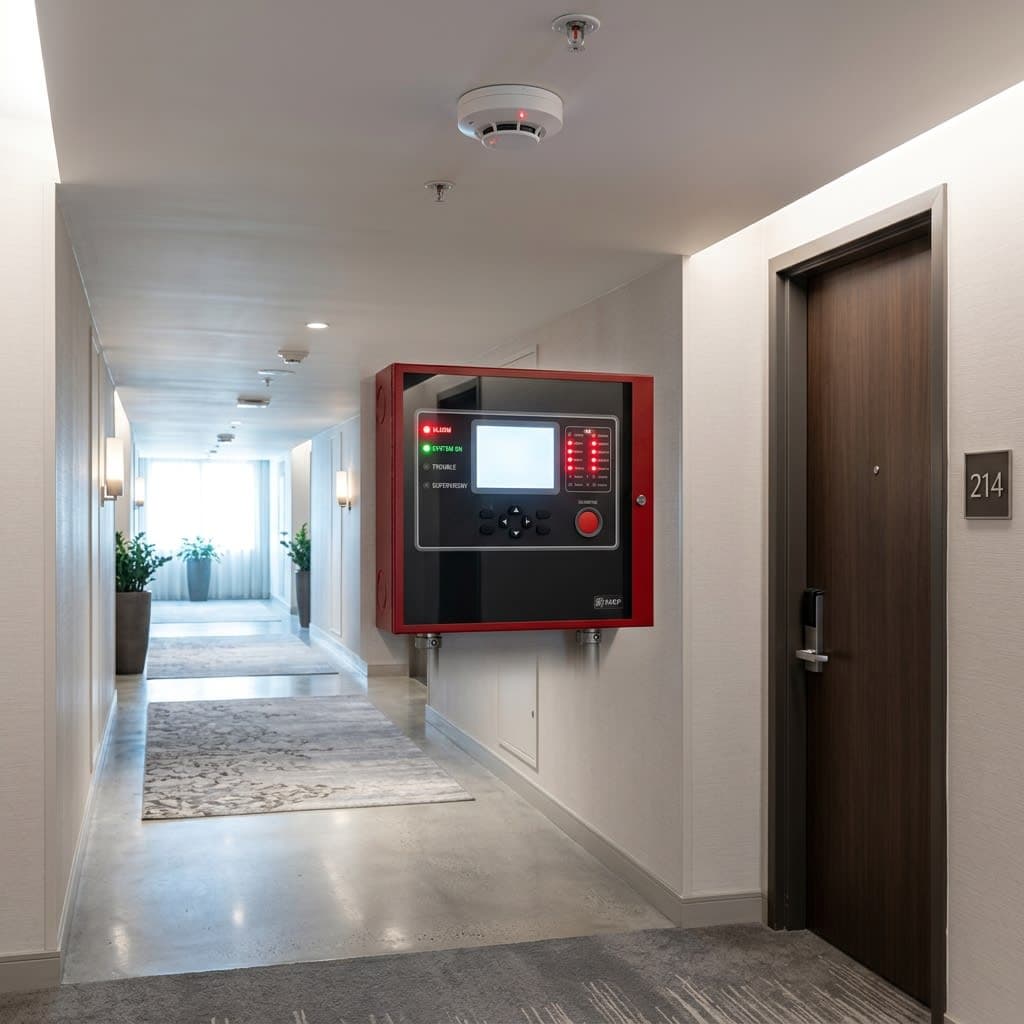
The fire alarm control panel is the brain that processes signals from all the detectors in a building. For high-rise apartments and hotels, choosing the right type of control panel directly affects the speed of incident response.
Criteria
Conventional system (usually)
Addressable system
Identify the location of the fire.
By zone
Exactly each specific newspaper
Investment costs
Lower
30–50% higher
Suitable for scale
Small building, few floors
Apartment buildings, high-rise hotels, many rooms
Scalability
Limited, difficult to integrate further.
Flexible, easy to add new addresses.
Fault diagnosis
It is difficult to identify the specific fault indicator.
Self-diagnosis, reporting errors for each individual address.
Evacuation time
Slower because the entire area needs to be inspected.
Faster — the fire department knows exactly which room is on fire.
Recommendation: For apartment buildings with more than 9 floors and hotels of 3 stars or higher, addressable systems are almost a mandatory requirement in fire safety design review due to their ability to accurately locate targets, thus shortening response time.
Fire alarm bells, indicator lights, and audible alarm systems.
When the sensor detects a problem, the system must trigger a sufficiently strong alarm to immediately alert everyone in the building, including those with hearing impairments.
Required warning components
- Fire alarm bell: Minimum volume of 75dB at a distance of 3m, ensuring clear hearing even in a closed room.
- Fire alarm strobe light: Mandatory in areas with hearing-impaired personnel or noisy environments (restaurants, hotel entertainment areas).
- Voice evacuation system: In hotels and high-rise apartment buildings, a voice evacuation announcement system provides more specific instructions than a simple bell, reducing panic.
Checklist of approved alarm systems
- The fire alarm bell/sirens provide sound coverage throughout the entire building area, with no sound blind spots.
- Strobe lights are installed in hallways, soundproofed rooms, and crowded public areas.
- The public address system incorporates evacuation scenarios for each area, preventing people from crowding into a single exit.
- Emergency fire alarm buttons (manual call points) are located on each floor, near the emergency stairwells.
Integrating Fire Alarm Systems with Elevators and Ventilation Systems
A modern fire alarm system does not operate independently but must be integrated with other building technical systems to ensure maximum safety in the event of an emergency.
Integrated with elevators
When a fire alarm is triggered, the system must automatically:
- Bring all elevators to the ground floor (or designated refuge floor) and open the doors, then lock them in place.
- Prevent people from using the elevator in an emergency — they must use the emergency stairwell.
- Activate the dedicated fire elevator (if the building is equipped with one) to allow firefighters quick access to the upper floors.
Integrated with the ventilation system, stairwell pressurization.
- Automatically shut down the central air conditioning (HVAC) system in the fire area to prevent smoke from spreading through the air ducts.
- Activate the pressurized stairwell ventilation fans to create positive pressure and prevent smoke from entering the refuge area.
- Activate the corridor smoke exhaust fan on the floor where the incident occurred.

Periodic Inspection: A Mandatory Legal Requirement
Many developers and apartment building management mistakenly believe that installing a fire alarm system fulfills their obligations. In reality, periodic inspection is a mandatory legal requirement under current fire safety regulations.
Recommended inspection schedule
- Monthly: Visually inspect the control panel, status indicator lights, and test the emergency push button.
- Every 6 months: Check all smoke detectors and heat detectors using specialized testing equipment, and check the backup battery.
- Every 12 months: Comprehensive system inspection by a fire safety certified unit, including integrated testing of elevators and ventilation, with a completed acceptance report on file.
Consequences of skipping inspection
- The system may not function during a real fire due to dusty detectors, dead batteries, or faulty signal wiring.
- Violations of fire safety regulations can lead to administrative penalties, or even suspension of building operations.
- Management will face serious legal liability if any loss of life occurs due to system malfunction.
Quang Duc's Fire Alarm System Installation Service
Quang Duc Electronics and Telecommunications Co., Ltd. provides complete automatic fire alarm solutions for apartments and hotels in accordance with TCVN 5738:2021 standards, including:
- Consulting on fire alarm system design suitable for the scale of the project, and assisting with fire safety approval documentation.
- We supply and install genuine, quality-certified smoke detectors, heat detectors, and flame detectors.
- Construction of an addressable fire alarm control panel, integrated elevator, and pressurized ventilation system.
- Regular inspections must be conducted according to the legally mandated schedule, with full documentation provided.
- Emergency maintenance and repair available 24/7 in case of system failure.
Quang Duc's technical team has experience in implementing fire protection systems for numerous apartment buildings and hotels, ensuring full compliance with legal regulations and practical safety for residents and guests.

Conclude
An automatic fire alarm system is not simply a mandatory legal requirement according to TCVN 5738:2021 — it is the most important layer of protection for lives and property in apartment buildings and hotels. From choosing the right type of detector, investing in an addressable fire alarm control panel, integrating with elevators/ventilation systems, to maintaining regular inspections, each element contributes to ensuring the system operates accurately when needed most.
Contact Quang Duc today for consultation on the design and installation of a standard fire alarm system for your project.
Hotline: 0903 306 126 (Mr.Vũ Trần) | Website: cameraquangduc.vn