Facial Recognition for Access Control: The Enterprise Security Trend of 2026
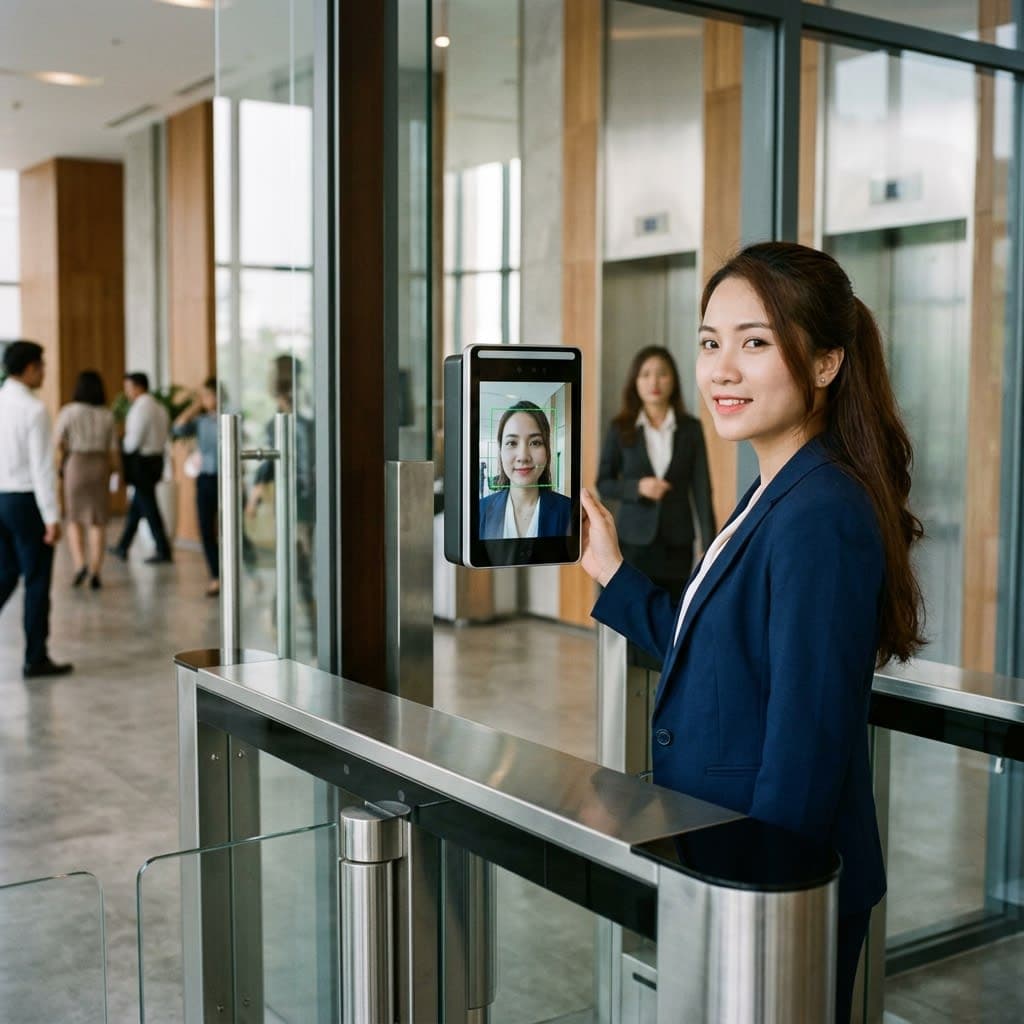
Face recognition technology has advanced significantly in the last three years, with accuracy increasing from 92% (2022) to 99.7% (2026) under challenging lighting conditions and less-than-ideal angles. According to security industry statistics, over 35% of medium and large businesses in Vietnam have switched from fingerprint/card access control to face recognition in the past two years, primarily due to its three-times faster processing speed and contactless hygiene.
This article delves into the technical aspects of facial recognition technology —its underlying algorithms, actual accuracy, security threats to be aware of, and trends in 2026—helping businesses understand the technology before investing in a facial recognition access control system.

The Foundation Algorithm for Facial Recognition
Facial Feature Extraction
Modern systems use deep convolutional neural networks to extract facial embedding —a 128–512-dimensional arithmetic vector that uniquely represents each person's facial structure, including:
- The distance between the eyes, the bridge of the nose, the jawline.
- The geometric ratio between facial landmarks — typically 68 or 106 points.
- Skin texture and microscopic features do not change with facial expressions.
Matching & Verification
The acquired feature vector will be matched against the registered database using Cosine Similarity or Euclidean Distance measurements. The acceptance threshold is typically configured at 0.35–0.45 to balance accuracy and false rejection rate.
- 1:1 Verification: Matching a face to a specific profile (used to verify employees who have previously scanned their cards).
- 1:N Identification: Matches against the entire database to automatically identify the identity — suitable for cardless access control.
Actual Accuracy and Influencing Factors

Condition
Average accuracy 2026
Good lighting, frontal angle.
99.5–99.9%
Low light/backlight
95–97% (with IR assist)
Wearing a mask partially
97–98% (eye-forehead recognition algorithm)
Wear glasses, change your hairstyle.
98–99%
Angle of inclination greater than 45 degrees
85–90% (standard viewing angle camera installation is recommended)
Average processing speed
Under 0.5 seconds per recognition
The actual accuracy depends not only on the algorithm but also on the quality of installation : camera angle, installation height (recommended 1.5–1.8m), and supplemental lighting conditions using infrared (IR) lights for low-light areas.
Anti-Counterfeiting Technology (Liveness Detection)

One of the biggest security risks of facial recognition is spoofing using printed photos, replayed videos, or 3D masks. Next-generation Liveness Detection technology addresses this problem through:
Active Liveness
- The user is asked to perform actions such as blinking, turning their head, and opening their mouth according to random instructions.
- Increased safety but slower processing speed by 1–2 seconds.
Passive Liveness
- Analyzes skin texture, natural light reflection, and 3D facial depth using dual infrared (Dual IR/RGB) cameras.
- Counterfeiting detection in under 0.3 seconds without any additional user action.
- It's the most popular technology in 2026 thanks to its seamless experience and lack of disruption to the flow of people entering and exiting.
Checklist for evaluating anti-counterfeiting systems before investing:
- Supports built-in Passive Liveness Detection.
- Dual RGB camera + infrared/depth sensor
- The rate of preventing photo/video forgery is over 99%.
- It does not require complex operations that would inconvenience employees.
- There is a log alert when a spoofing attempt is detected.
Integrating Facial Recognition with Enterprise AI Cameras
The trend for 2026 is to build a unified security ecosystem instead of disparate devices:
- Sharing facial databases: AI security cameras and time attendance devices share a single facial database, reducing duplicate registration costs.
- Continuous alerts: When the AI camera detects a stranger in a restricted area, the system automatically compares their face to a list of registered employees to classify the alert as real or false.
- Tracking movements: Combining data from multiple AI cameras to reconstruct an individual's movement path across the entire campus — useful in incident investigations.
- 50% reduction in terminal devices: Some high-end AI cameras integrate access control modules directly, eliminating the need for separate readers.
Facial Recognition Technology Trends in 2026
- Combining AI with emotion analysis: In addition to identity verification, the system can detect abnormal states (stress, agitation) to support proactive security.
- Detecting abnormal body temperature: Integrated thermal cameras alert employees showing signs of fever, supporting disease prevention in crowded factories.
- Comprehensive Edge AI processing: The entire recognition process takes place directly on the device, eliminating the need to send facial data to cloud servers — enhancing personal data security in accordance with Decree 13/2023/ND-CP on personal data protection.
- Processing speed under 0.3 seconds: Suitable for high-traffic flow in factories and large office buildings without causing congestion.
Comparing Facial Recognition with Other Authentication Methods
Criteria
Facial recognition
Fingerprints
Magnetic cards/RFID cards
Processing speed
Under 0.5 seconds, no contact.
0.5–1 second, needs to touch the correct spot
Instant, but you need to bring your card.
Hygiene
No contact at all.
Direct contact with the sensor surface
Avoid direct physical contact.
Fraud risk
Low thanks to Liveness Detection
Average (fingerprints can be forged)
Cao (borrowed/lost timekeeping card)
Equipment investment costs
30–50% higher than fingerprints
Medium
Lowest
Maintenance request
The lens needs to be cleaned regularly.
Sensors wear out easily and lose sensitivity over time.
Low maintenance, card reader prone to failure.
Suitable for the environment
Clean offices and factories
Dry hands
All environments, including light dust.
In many real-world deployments, businesses combine both facial recognition and card access as a backup option when cameras experience lighting issues or temporary connection loss.
Biometric Data Security Risks to Be Aware Of
Facial data is sensitive biometric information, requiring businesses to protect it rigorously:
- Data encoding and storage: Facial feature vectors need to be encoded, not stored as original images that can reconstruct the face.
- Access control: Only authorized administrators can access and edit the employee facial database.
- On-premise processing instead of public cloud: Reduces the risk of data leakage when transmitting over the internet, especially important for businesses with high security requirements.
- Notification and Consent: Employees must be clearly informed about the collection and storage of facial data in accordance with applicable laws and regulations.
- Data deletion process: There is a mechanism to delete facial data when an employee leaves the company or upon request.
Quang Duc's Facial Recognition Access Control Service
Quang Duc Electronics and Telecommunications Co., Ltd. is implementing a facial recognition access control solution using the latest AI technology:
- Consultation on selecting a Passive Liveness Detection device suitable for the installation environment.
- Survey the location, calculate the optimal camera mounting angle and lighting for the best recognition accuracy.
- Integrate facial data with existing AI surveillance camera systems and time attendance software.
- Training administrators on operations and troubleshooting false positive identification issues.
- Comply with personal data protection regulations when storing and processing biometric data.

The Process for Deploying a Facial Recognition System for Businesses
To achieve optimal results, the implementation process should follow these steps:
- Site survey: Measure actual lighting at installation locations, determine appropriate camera mounting angles and heights.
- Equipment selection: Consider the choice between a dedicated access control device (access terminal) and a multi-functional integrated AI camera.
- Facial data registration: Collect employee facial images from various angles and lighting conditions to increase recognition accuracy.
- Configure access control: Set entry and exit times and permitted access areas for each employee group.
- Real-world testing: Conduct trials with various subjects and lighting conditions before official commissioning.
- Training and handover: Guiding administrators on operation, handling false positives or access denials.
Checklist before system acceptance testing:
- The success rate of identification is over 98% under actual on-site lighting conditions.
- Average response time is less than 1 second per gate pass.
- Anti-counterfeiting testing was conducted using printed images and video playback.
- There is a backup plan (magnetic card/PIN code) in case the system malfunctions.
- Facial data is encrypted and access is clearly defined.
Actual Deployment Time by Scale
Business size
Number of installation points
Estimated deployment time
Under 50 employees
1–2 entrances
2–3 days
50–200 employees
3–5 gates, multiple floors
5–7 days
Over 200 employees, factory
6 or more ports, integrated AI camera
10–15 days
Conclude
By 2026, facial recognition technology has reached a level of maturity sufficient to become the preferred choice for enterprise access control—fast, contactless, and robustly resistant to spoofing. However, actual effectiveness largely depends on the quality of installation, the selection of reliable Liveness Detection equipment, and integration with existing security ecosystems.
Contact Quang Duc for a survey and consultation on facial recognition solutions tailored to your company's specific layout and workforce size.
Hotline: 0903 306 126 (Mr.Vũ Trần) | Website: cameraquangduc.vn