FTTH/FTTO Fiber Optic Cable Installation for Businesses: High Bandwidth, Low Latency
According to reports from VNPT and Viettel in 2024, over 68% of small and medium-sized enterprises (SMEs) in Vietnam upgraded their network infrastructure to fiber optic cables within the past three years, with an average deployment cost of 8-25 million VND for an office building with 50-200 employees. The demand for bandwidth is growing at an average of 35% per year due to cloud computing applications, 4K video conferencing, and real-time data backup, putting significant pressure on traditional copper network infrastructure. This article provides a comprehensive analysis of the FTTH/FTTO fiber optic cable installation process for businesses, helping IT managers make informed investment decisions.
FTTH and FTTO: Core Differentiators for Businesses

FTTH (Fiber to the Home) — A Solution for SOHO and Small Offices
FTTH is a bandwidth-sharing model where multiple subscribers share a single fiber optic cable from the central office to the distribution point (splitter). With popular packages of 100Mbps–1Gbps in the Quang Nam–Da Nang market in 2025 (ranging from 180,000–850,000 VND/month ), FTTH is suitable for SOHO offices with fewer than 20 employees and does not require strict SLA uptime.
Limitations of FTTH in a business environment:
- Asymmetrical bandwidth (uploads are typically 3–5 times lower than downloads)
- There is no SLA guaranteeing uptime (usually 99.5%).
- Bandwidth sharing during peak hours may be reduced to 30–40% of the promised speed.
FTTO (Fiber to the Office) — Enterprise Private Internet Connection
FTTO provides dedicated fiber optic cables from the network operator's data center directly to the enterprise's CPE equipment, without using splitters. It offers symmetrical bandwidth from 100Mbps to 10Gbps , a 99.9% SLA guarantee, and 24/7 technical support.
FTTO costs in Da Nang in 2025: from 2.5–12 million VND/month depending on bandwidth and provider. This is a mandatory option for businesses operating cloud ERP, internal data centers, or centralized CCTV systems.
Single-Mode vs. Multi-Mode Fiber Optic: Choosing Based on Infrastructure

Core Technical Specifications
Single-Mode Fiber (SMF — G.652D/G.657A): 9µm fine fiber core, transmits only one mode of light, extremely low attenuation (~0.35 dB/km at 1310nm and ~0.20 dB/km at 1550nm). Suitable for distances from 1km to 80km without amplification.
Multi-Mode Fiber (MMF — OM3/OM4/OM5): 50µm or 62.5µm fiber core, transmits multiple modes simultaneously, suitable for short distances (<300m with 10GbE). Higher attenuation than SMF but allows the use of lower-cost VCSEL transceivers.
Single-Mode vs Multi-Mode Comparison Table
Criteria
Single-Mode (SMF)
Multi-Mode OM4
Core diameter
9 µm
50 µm
Maximum distance
Up to 80 km
Up to 400 m (10GbE)
Maximum bandwidth
100 Gbps+
25 Gbps (OM4)
Wavelength
1310 / 1550 nm
850 nm (VCSEL)
Transceiver costs
Higher (~1.5–3x)
Lower
Typical applications
Inter-building, WAN, campus
Data center, internal backbone
Recommendation
Distance >100m or future upgrade
Distance <300m within the building
Practical recommendation: For businesses in Da Nang-Quang Nam with multiple branches or interconnected buildings, SMF G.657A2 is the current standard due to its small bending radius (7.5mm), making it convenient for routing cables in tight conduit.
GPON Architecture: A Passive Optical Network Platform
GPON Operating Principle
GPON (Gigabit Passive Optical Network — ITU-T G.984) is the most popular passive optical network technology in Vietnam, using passive optical splitters to distribute signals from a single OLT (Optical Line Terminal) port to multiple ONUs/ONTs at the customer's end.
Common split ratios:
- 1:32 — for use in high-density residential areas or enterprise FTTH
- 1:64 — Cost optimization but reduced bandwidth per subscriber
- 1:16 — for FTTO, quality is prioritized.
GPON bandwidth: 2.488 Gbps downstream / 1.244 Gbps upstream shared between ONUs within the same PON port. XGS-PON (10G-PON) is being deployed from 2024 with 10 Gbps symmetrical .
ODF and Patch Panel Design
An ODF (Optical Distribution Frame) is the central management point for the entire fiber optic cabling system in a building. A standard ODF design for a business building needs to ensure:
- 30% reserve capacity for future expansion.
- Use an LC/APC connector (green) for the SMF in a GPON environment to reduce backlighting.
- The OS2 patch cord is yellow to distinguish it from the multi-mode cable.
- Cable labels conform to TIA-606-C standard for easy management.
Fiber Optic Cable Splicing Techniques: Fusion vs. Mechanical Splicing

Fusion Splicing — Industry Standard
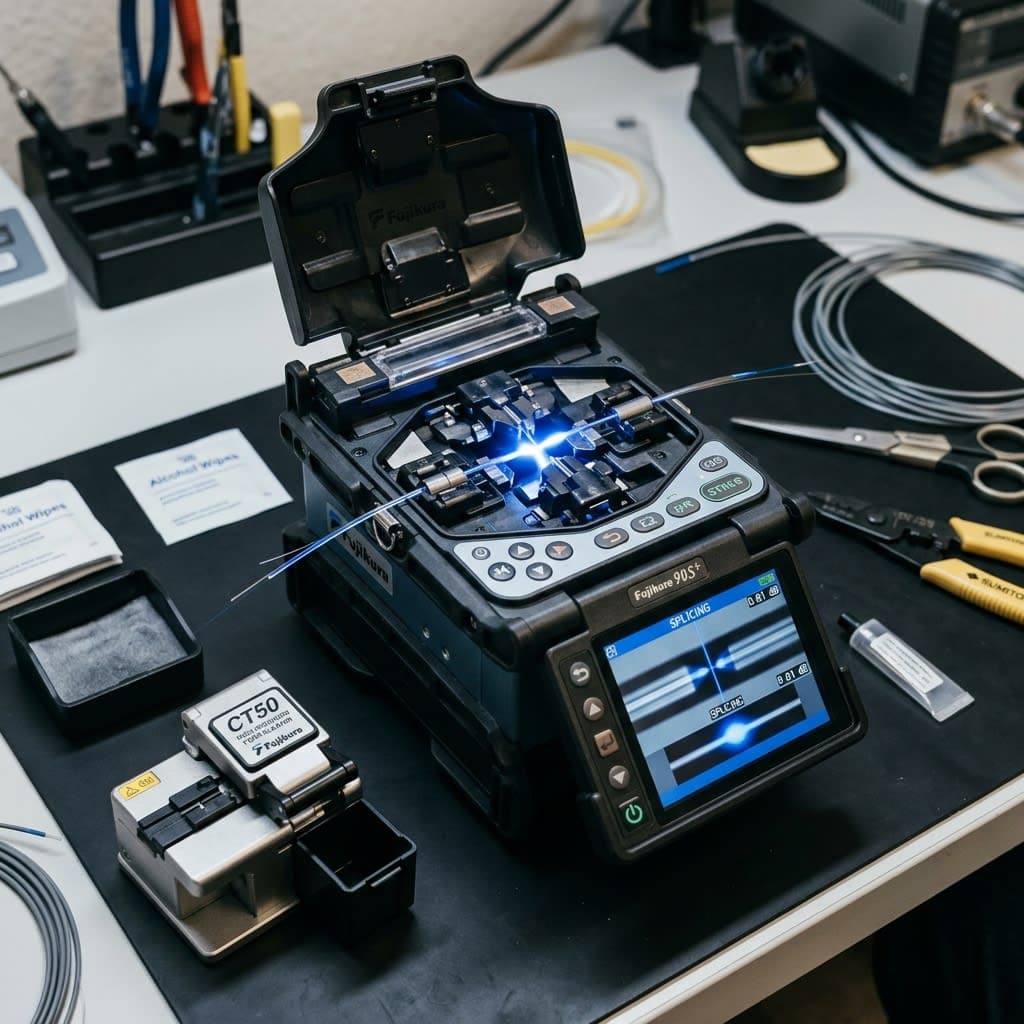
Fusion splicing uses a fusion splicer to melt and connect two optical fiber ends at a temperature of approximately 2,000°C . The result:
- Splicing loss: <0.05 dB (typically 0.02–0.05 dB)
- Mechanical strength: >500g tensile force at the weld point
- Weld life: >25 years under normal environmental conditions
Standard fusion splicing process:
- Remove the protective coating using a specialized tool.
- Clean the fibers with 99% IPA and a lint-free cloth.
- Cut the yarn using a cutting machine with a cutting angle of <0.5°.
- Align the fibers and solder them using an automatic fusion splicer.
- Heat shrink sleeve
- OTDR testing confirms attenuation.
Mechanical Splicing — An Emergency Solution
Mechanical splicing uses a mechanical clamp to hold the two ends of the fiber in contact. Typical attenuation is 0.3–0.5 dB , suitable for emergency troubleshooting when a fusion splicer is not available on-site. It is not recommended for long-term fixed systems due to high attenuation and lower durability.
Measurement using OTDR
An OTDR (Optical Time-Domain Reflectometer) is a mandatory device after every fiber optic cable installation project, allowing for:
- Precisely identify the location of the fault/weld, meter by meter.
- Measure signal loss along the entire line and at each connection point.
- Export the report as a PDF for archiving and use as a final acceptance document.
OTDR acceptance criteria: total line loss ≤ optical power budget, each splice <0.1 dB, each connector <0.3 dB.
Practical Application: Uplinking Between Buildings and Datacenters
Connecting Multi-Building Campuses
Businesses with multiple buildings on the same campus (factories, industrial parks, schools) often deploy underground conduit or aerial drop cable fiber optic backbones between locations. Recommendation:
- Use ADSS (All-Dielectric Self-Supporting) cables for outdoor suspension, capable of withstanding wind loads up to level 12.
- Submarine cables use armored direct-buried cables with a protective steel layer.
- Provide a minimum of 2 redundant fibers per direction for both primary and backup.
- Distance up to 2km: no amplification needed with SMF.
Internal Uplink Datacenter
Connecting from the MDF (Main Distribution Frame) to the server rack in the internal datacenter:
- 10GbE uplink: SMF OS2 + transceiver SFP+ 10G-LR (1310nm, maximum 10km)
- 40GbE/100GbE: MMF OM4 + QSFP+ 40G-SR4 or QSFP28 100G-SR4 transceiver (short range)
- Connection standards: MTP/MPO for 40G/100G parallel optic; LC duplex for 10G
Checklist for Fiber Optic Cable Installation and Acceptance Testing
Before Construction
- Conduct field surveys, draw cable route diagrams, and locate ODF/splitter positions.
- Calculate the optical power budget for each line.
- Confirm the type of cable, connector, and quantity of materials.
- Check the excavation permit (if excavating underground).
- Prepare the fusion splicer, OTDR, cutting tools, and peeling equipment.
During Construction
- Pull the cable to the correct minimum bending radius (typically ≥30mm with G.657A2).
- Label the cables at each connection point.
- Weld each fusion joint and perform an OTDR test for confirmation before closing the junction box.
- Record photos of the construction progress for each item.
Acceptance Testing
- Measure the entire route using an OTDR and save the data in a .sor file.
- Measure optical power (optical power meter) at each ONU/ONT.
- Test the actual speed (iPerf3) across the entire connection.
- Handover of completion documents: route diagram, OTDR results, construction log.
Quang Duc's FTTH/FTTO Fiber Optic Cable Installation Services
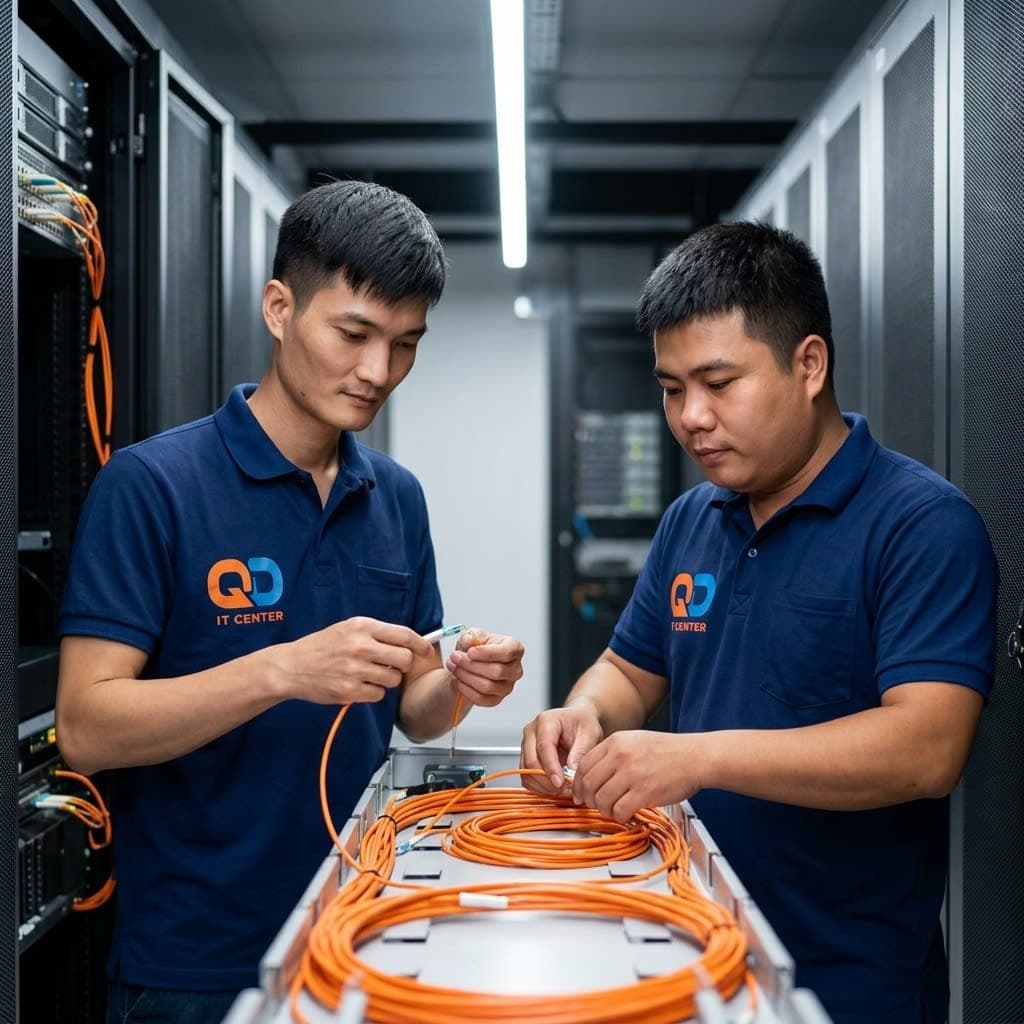
Quang Duc Electronics and Telecommunications Co., Ltd. provides comprehensive fiber optic cable installation solutions:
- Surveying, designing, and installing FTTH/FTTO fiber optic cable systems for offices, factories, and industrial parks in Quang Nam and Da Nang.
- Fusion splicing achieved attenuation of <0.05 dB/splicing, accompanied by an OTDR acceptance report.
- Install ODF cabinets, patch panels, and optical distribution systems according to TIA/EIA standards.
- Integrating fiber optic infrastructure with LAN networks, security cameras, and IP PBX systems.
- Regular maintenance, troubleshooting, and system expansion to meet growing needs.
With over 10 years of experience in telecommunications infrastructure construction in Quang Nam and Da Nang, Quang Duc's technical team has successfully implemented hundreds of fiber optic projects ranging from small offices to industrial parks, hospitals, and commercial buildings.
Conclude
Investing in FTTH/FTTO fiber optic infrastructure not only meets current bandwidth needs but also forms the foundation for a business's long-term digital transformation strategy. The right choice between single-mode and multi-mode fiber, the appropriate GPON architecture, and standard splicing techniques will determine the durability and performance of the entire system over the next 15–25 years.
Businesses in the Quang Nam-Da Nang region are facing a favorable period as major network operators are actively expanding their XGS-PON 10G infrastructure, creating opportunities for bandwidth upgrades at more competitive costs than ever before. Choosing a contractor with professional technical capabilities and testing equipment is a key factor in ensuring project quality.
Contact Quang Duc for free consultation, on-site survey, and a quote for FTTH/FTTO fiber optic cable installation tailored to your business's scale and budget.
Hotline: 0903 306 126 (Mr.Vũ Trần) | Website: cameraquangduc.vn